Play Make Write Think

Fantasy Football

The Longest Rainy Sunday
Fantasy Football
Loading
/

While baseball may still be on the books as “America’s favorite pastime” it is very clearly no longer America’s favorite sport. As baseball fans clutch onto pre-war glory days of the previous century, filled with legends like Babe Ruth and Joe DiMaggio, they stay memories. Slowly fading into obscurity with lowered fan attendance and network ratings, the future of sports has pivoted towards more action packed games with more concise seasons – football and basketball. Football – Gridiron football, a game so American almost no one else outside of the hemisphere plays it – has been a shining success in usurping the throne as a cultural mainstay, with games regularly topping viewership records and the cementing of the Super Bowl as a national holiday. With this huge boom in popularity in the information age, both of these sports have experienced the effect of a novel interloper: fantasy leagues.

Sources

Transcript

Download transcript

Twine Game Reflection

Making a new game was definitely a new process for everyone in our group. We were confused and had no idea at the very first. Approaching deadline, we started to dig deeper in the topic and focus more on the phase “social issue”. It was the breakthrough of our work and we started to brainstorm from there. Since we all watched different dramas from all over the world, we raised the idea that why not we adapted the idea from the Japanese TV drama “Unnatural” to design a game talking about school violence, knowing that school violence is becoming more and more common these years and the power of the internet cannot be ignored. With the consent of all group members, we started to write our original adapted plots. I mainly focused on writing the original adapted plots by rewatching the episode again so that the other team members could revise it into a game format. To make it more engaging, we made it different choices, so that players could be absorbed into the story in the game while playing it and reading some fun choices. The plots are revealed as a conversation format with some dark background musics. The final product took us a big amount of time and we gradually went very into this assignment; we divided each part of our introduction of presentation to our game properly before game. The product looks very good to all of us and we were satisfied about its reflection on the society.

Podcast Reflection – Super Odyssey in Quarantine

In this episode of the series, I serve as the team’s producer. The process of developing and producing our podcast is very straightforward but also challenging. I firstly picked up a game that should be familiar with many people. But this version of the game, Super Mario Odyssey, also has its distinction from the previous version that it sets improvements and builds more connections with the modern world. At first, when we were all still at the older version stage, we were hard to think about the main points we want to talk in our podcast. But once we were becoming more into the game and realizing the connections with the versions and thinking about the game as a series, we decided to analyze our podcast into three parts: something remaining, something new, the conclusion. My primary goals are to not only build connections between the new version of the game with the older ones, but also bring this week’s episode with our last two. We did this by highlighting our points, quarantine, probing, etc. Also, similar from the style of our last few episodes, I tried to remain our podcast as a casual talk to make it interesting and relaxing. And from those processes, I learned more that it is through play, real life, and creation, we are able to create more and more possibilities; the skills in broadcasting and video-editing are definitely new to me and will be useful in my future life.

Is Moderation the Solution?

The Longest Rainy Sunday
Is Moderation the Solution?
Loading
/

The 2020 US presidential election might be over, but just as other elections in the past, its stories and lessons remain: why did the winner win and the loser lose? What issues do American care deeply about at this moment? How will the country look like 4 years from now? Each question unfolds other questions that would take forever to find the right answers. Luckily, Democratic Socialism Simulator will help us solve part of our wonders, if not all. In this episode, we examine the choices a president makes during his/her term as well as the repercussions they bring. We hope you will gain insights into what makes a successful presidency. 

Sources

  • Flanagan, Mary. Critical Play: Radical Game Design. p. 4-6 Cambridge, Massachusetts: MIT Press, 2009.
  • Johnson, Steven. Everything Bad Is Good for You: How Today’s Popular Culture Is Actually Making Us Smarter. p. 26-27. New York: Riverhead Books, 2005.
  • Ketsa. “Empty Playground.” Free Music Archive.
  • Engel, Kai. “Homeroad.” Free Music Archive.
  • Democratic Socialism Simulator by Unity, 2020

Transcript

Download transcript

Journey through Quarantine

The Longest Rainy Sunday
Journey through Quarantine
Loading
/

In this episode of The Longest Rainy Sunday, we look at Journey; a game that is seen as a work of art by many. Journey certainly has its complexities beneath the stunning visuals and simple concept. In this episode, we analyze the meaning behind the Journey through probing, analyzing the multiplayer aspect, relating it to the current COVID-19 pandemic, and much more. Enjoy our take of the indie adventure-game, Journey. We can make it through this journey together!

Transcript

Download transcript

Twine game reflection

My experience making a Twine game was challenging yet interesting. Since I was doing it on my own and taking all the roles, I had the freedom to steer the story to the direction I want without compromising with anyone else. Learning how to use Twine and making sense of the mechanics was a problem at first. After knowing how Twine work, I immediately thinking of Tangaroa Deep, a game we played this semester, since it involves picking out options to progress through the game. I wanted to create a game that follows a chronological order but at the same time has multiple unpredictable outcomes depending on how a player plays the game. Tieing that idea with a social issue, I made a video vlog type of game in which I show a day in the life of a college student in the pandemic. This kind of daily vlogs were really popular on youtube in the past and I think they are even more relevant now when life satisfaction is low.

Overall, I think the presentation turned out well and I made some progress in writing the plot. The overall tone of the game is depressive and monotonous, which are emotions and thoughts of my character. Going forward, I will make a tragedy happen, possibly suicide of a fellow classmate due to mental health issues and some unfortunate events. This will cause the main character to be grateful for what he/she is having compared to others in these trying times – a roof to stay under, strong internet connection, an education he deserves, etc.

Making a Twine game was also a unique experience. It forces me to think in multiple scenarios and dimensions rather than linearly like how I usually write an essay or story. I find it similar to coding as well, except without an objective. I create the objective for myself. Completing this project is another way I have produced content through written text this semester, as with other methods like writing a podcast episode script, reflecting on my experiences, or liveblogging games. But as stated above, when making a Twine game I have to think of different scenarios and how to connect the branches instead of thinking linearly like in other works. I have learned to think gamefully and write critically through these experiences, and I will carry them to other assignments and classes in the future.

Plague Inc. Podcast Reflection

As the line editor, I would still like to reflect and discuss on the process of making this episode. In our group, we usually evenly split up the work, which mean that no matter the role, we put similar amount of input and ideas into the podcast. The reason why I was assigned line editor was because I am a producer who’s more efficient in editing audio clips. For this episode, we worked on a game that I have played throughout my childhood. The Plague Inc. went viral immediately when it came out a few years ago. At the time, I did not expect an actual global pandemic to ever happen in my life. However, when we brainstorm as a group and played the game together, I realized that all the things that are mentioned in the group had happened and is happening to our world. During the podcast, I tried to contribute my personal experiences and feelings toward this game. I think everybody had a chance to discuss about specific parts of the game that they liked and relate the game to our current circumstances.

Visual Note Taking

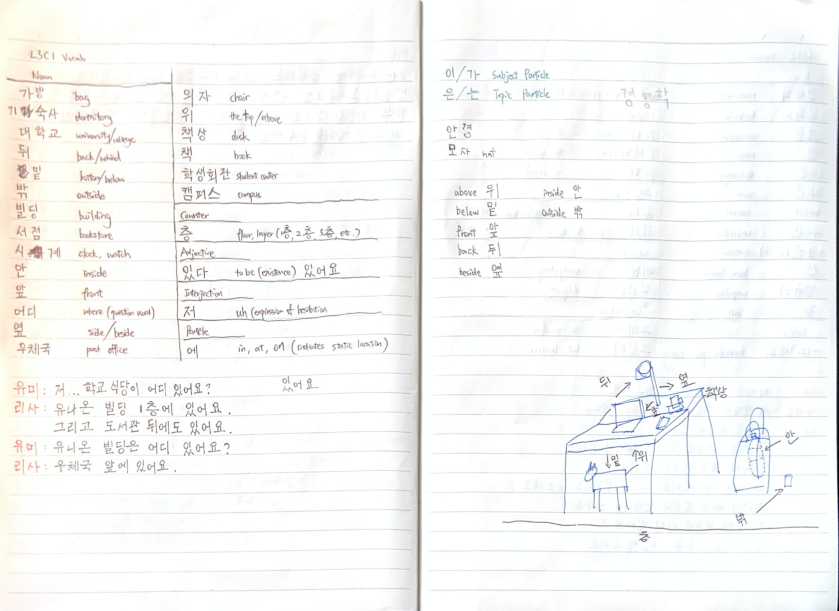
For this assignment, I made a visual note on a Korean 101 class I was studying for. The main intent of the visual note was to help me understand and memorize the pronunciations and distinctions between the vocabularies regarding physical relationships and comparisons, which I had some struggles with. The drawing came to me pretty naturally, since this unit of vocabularies was about relationships between objects. One aspect I would work on in the future when taking notes would be incorporating the visuals into the whole page, instead of only one corner of the notepaper. Another potential approach would be to use my digital tools (iPad or PC) to take notes. It would have been easier for coloring and more pleasing visual elements. However, I prefer drawing on paper because of the unique texture it gives, and writing on paper helps with memorization.

“Kobe!”

As a passionate basketball player, I always played around with my friends back in middle school classrooms, throwing bottles and paper, dribbling them under our legs and behind our backs and trying to score imaginary baskets with them. Whenever we make a confident shot from afar, we always yell, “Kobe!”, to dedicate the shot to our favorite basketball player. The year 2020 was very difficult in that our idol has passed away, and the pandemic is limiting our chances to play basketball. On top of the video, I put the audio of a basketball game when Kobe Bryant had beat the buzzer to win the game for his team.

Gris Response

00:05

My first impression of the game Gris was how beautiful the visual elements were. The visuals were displayed in a watercolor manner that illustrates strong emotions within. At first, I did not understand its control mechanism. Out of my previous experience with gaming and platform games, I instantly went to the arrow keys and the “WASD” keys to move the character. I realized that the only thing I could control was “A” and “D” to move the character left and right.

00:09

Soon, I’ve figure out how to jump with the space bar. The game aesthetic continues to develop and unfold into a clearer blueprint. The main character seems to not be able to find colors in the world she lives in, and she is on a quest to bring back the colors to her world. On her journey, she is joined by those tiny “stars” that follows her and gives her abilities.

00:28

I seem to have finished the first level and brought back the color red. As this game progresses the visual becomes more impressive with its simplistic yet full-of-detailed hand drawn background. Through the whole level I had barely seen any verbal cues or directions. It was simply the colors and images that conveyed the emotions on me. The character seems to be in grief, and the game “Gris” (as I remembered to be the color grey in Spanish), is trying to bring back colors back to her inner world, filled with greyness, storms, and abandoned buildings. I think the game, until this point, was very powerful in conveying its emotional messages to me. I was fully involved while playing this game and cannot wait to explore more.

css.php