Side Quest 10: Assemblies
ENG101, section 05. Fall 2020. Emory University.
This is a scene from Titanic when Jack and Rose hugged each other.
This is a scene from Titanic when Jack and Rose hugged each other.
My main role in creating the twine game was to create the story. I needed to establish a backstory and key character conflicts for the main character in order to progress the theme of hopelessness, perseverance, drama, and conflict during quarantine. We decided to focus on the story of the game first, and then we would move onto the mechanics of the game and putting it into twine. After the story, we wanted to think of ways we could engage the player in our game. One mechanic we hoped to include was a meter that tracked two different factors, health and resolve. These things were measured by tracking the character’s physical, mental, and social health as well as energy/drive, achademics, trauma, and future. We tried to add as much positive feedback into the game as possible. Since twine is more of a coding program and its difficult to work together, we decided to make Ranjan in charge of putting the game itself into twine, while the rest set up the framework for the game. In our game we did a very good job of involving the player by giving them decisions to make, and allowing them to see their decisions play out in game. By doing this I learned how to portray themes through the actions and decisions a character makes. I had to methodicaly decide which action made which bar go down. This will help me in future writing because it will allow me to analyze characters better because I have experience creating one myself.

It is really easy for me to get distracted. On my class notes, it will be often to find sketches or things that are hundred percent not related to the course. This is my notes from accounting class. We were learning the market value of a company, and multiple formulas. I just started to use my iPad to take notes, using digital drawing tool to take notes actually made the process of note taking to be interesting.
The main thesis of the essay is about how the coping of trauma propagates the feeling of empathy for the characters involved who are jumping over the imposing hurdles of trauma.
I thought that writing an inductive essay was much harder than writing a deductive essay. In my writing upcoming, I was accustomed to writing a standard 5 paragraph essay: the introduction states the main thesis of the essay, the 3 body paragraphs each support the main thesis with different reasonings, the conclusion paragraph brings the essay to a natural ending and reinstates the main thesis. Saving the thesis for the very end felt weird to do. From a structural viewpoint, I feel like writing the body, support paragraphs following the introduction helps me as a writer because I am constantly aware how to connect the body paragraph back to thesis. When I have the thesis at the end, especially when the thesis is underdeveloped, writing a thesis statement that forcibly connects the body paragraphs seems difficult to do.
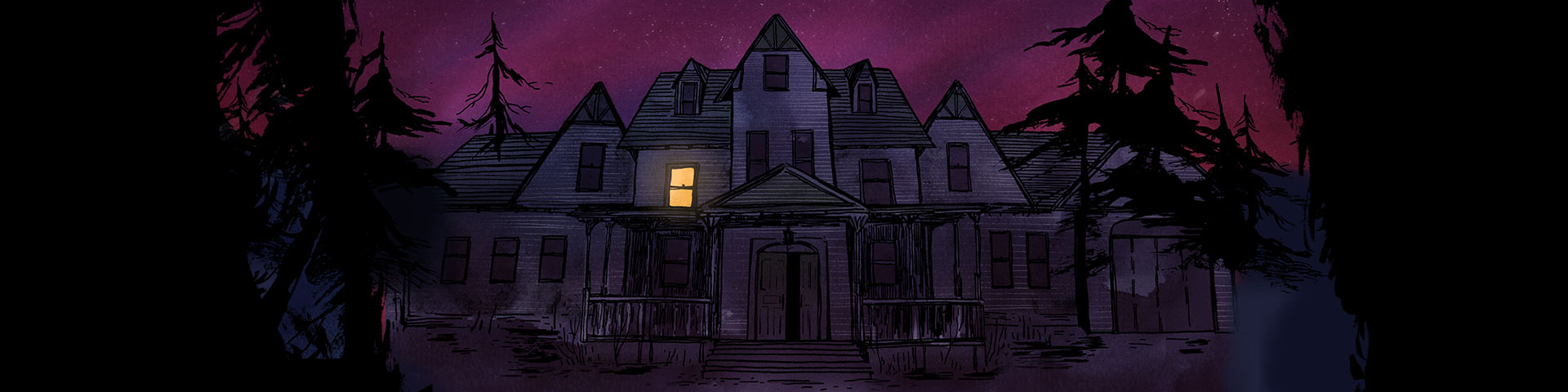
In frank words, I am not sure I correctly followed the Professor Morgen’s intended structure. The purpose of the prompt to compare 2 games—in my case, Gris and Gone Home—I wrote the first 2 paragraphs contrasting the clearly different games. I then dedicated the last 2 paragraphs to how the games involve the theme of trauma and coping of trauma. The very last paragraph continues the discussion of the third paragraph and connects how the characters’ dealing with trauma forces us to empathize with the characters.
I learned about the inductive essay format because it was my first time writing it. I was surprised at how challenging it was for me to write it. I’m not sure if the difficulty originated from the fact that I hadn’t played the 2 games for a long time or because of the inductive essay structure. If I had a choice, I would much prefer writing a deductive essay than an inductive essay.
Find the game comparison essay here
To structure my essay in a reversed order is an exciting but challenging try for me. I enjoyed the process of simply starting to write without worrying about a big, eye-catchy, and demanding thesis. However, as I went further, I noticed that I lost track of what I wanted to say. I jumped from ideas to ideas and it was hard for me to keep writing, being confused and not knowing where I really wanted the essay to go.
There were three parts of this essay. The first two were two contrasts that I recognized and the last part was a main thesis part…
I learned that writing in a reversed order does not mean that we do not need to know what we’re supposed to write about from the beginning. It actually means that we need to have a better sense of what we’re writing.
To read my Game Comparison Essay, please click here.
CHECK OUT THE EPISODE HERE!
My co-producer Sam Grant and I split up the work the same way we did on our previous podcast episode, understand the playthrough through playing the game or watching videos, grouping together to generate ideas, formulating the podcast, producing the podcast, then finally he edited the episode. At the same time, I did all the other manners that needed creating. Our episode adapted from our previous episode by focusing on our perspective of the game because it is about enjoying their own experience. Additionally, we gained inspiration from our peers’ more significant comparisons to the pandemic in our newest podcast episode about Journey.
The goal of the episode we produced was to spotlight a game that people can significantly relate to during the COVID-19 pandemic, going through an unknown world completely alone. Loneliness has been a more outstanding issue than ever before due to the conditions put forth due to precautionary measures. However, producing this episode was somewhat challenging to reflect and ponder the idea of loneliness. Furthermore, the current episode production was put on a relatively tight time constraint due to the dropped episode’s conditions prior. If I had more time to produce the episode, I would have had the opportunity to play through Journey numerous times because of the different scenes and options available, allowing me to have a greater connection to the game and thus the podcast production.
Sam and I mainly put a tremendous amount of work into this podcast production, trying numerous times to communicate with others to no avail. We produced an episode that analyzed an entire game, evaluating the game through our perspectives. However, when it came time to create the podcast, we collaborated thoroughly with minimal hindrances. I was better able to gather the outlying factors to the episode, and Grant was able to be better edit the episode into our image. The Journey through Quarantine podcast episode had its charms and quirks, but we are okay with that; it is unique.
CHECK OUT THE EPISODE HERE!
CHECK OUT THE PODCAST HERE!
The Portal podcast was split between the co-producers, Sam Grant and Brady Dolan (myself). Since Sam had already played Portal in the past, he watched Youtube videos to jog his memory while I played through the game. We both made sure to split the work relatively evenly. After he and I were aware of the playthrough, we brainstormed what we could take away from the game in an online call—both suggesting themes for the podcasts, resembling the podcast to other previous episodes, and how to make our episode stand out, which was the primary goal of the episode. Though we continuously argued back in forth between the podcast’s theme, we were able to produce an episode that shared both of our ideals.
We decided about the episode by reading articles and online videos about the lore behind the game and hidden meanings. After we decided upon a central idea for the podcast, we went through the vocabulary to search for terms that we noticed in Portal, writing what Portal aspects related to the word.
After constructing that aspect, we chose orders to put the terms in the podcast, allowing us to introduce the terms as we chronologically went through the game. In our Portal podcast episode, we focused on gameplay first, then the backstory, and finally the connections of our central theme to Portal, allowing an understanding of all of Portal’s details by the viewers. From our peers’ podcast episodes, we understood we had to restrain ourselves from only giving positive feedback about the game, including our fair share of criticism. Though our episode revolved around quarantine, we chose to invest in the pandemic’s emotional aspect of our relationships with others.
After we went over the podcast script, we attempted the podcast several times to fix the script’s issues not sounding natural. By the end of the podcast, we had established an idea of how to format the avatar, description, title, and background music. As Sam begin to edit the podcast, I worked on the remaining material. I favored this splitting of the work because I am not experienced with editing, and I already had an idea in mind of how I wanted the podcast’s avatar to look. Our collaboration throughout the podcast made the production a lot simpler despite it being on two members. We had to look at writing our podcast as a process that takes time to produce, not cramming all podcast production into a day. Sam and I created a podcast with minimal experience, but I believe we did a great job with the tools with had.
CHECK OUT THE PODCAST HERE!

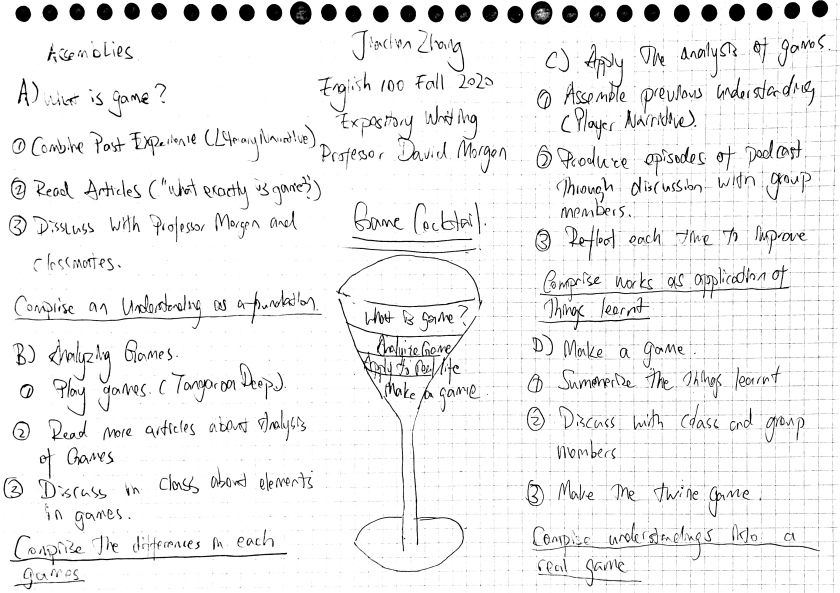
For some unknown reason, the National Archives includes a document entitled Cocktail Construction Chart, which was created by the US Forest Service in 1974, showing recipes for a group of cocktails represented in the style of an architectural diagram.
For this week’s sketch, think about the work you’ve completed in this class and your own learning and thinking processes — then break all that down into component parts, represented in some sort of an architectural diagram like this one. I’m less interested in the quality of the drawing itself and more in your analytical ability to break down something complicated into a series of steps and to represent that as if in such a diagram. Think of it as a kind of telescoping.
Creating this diagram should be a key step towards completing your portfolio reflection letter (and I will encourage you to use the diagram as a key image in that letter). If you think about what you have learned this semester about yourself as a writer and reader, how can you represent that understanding as a single diagram, and how do the various pieces of writing you have done fit into that diagram to construct your vision? You might want to refer, once again, to the learning outcomes for this class as you you put together your assemblies.
