Play Make Write Think

Assemblies

For this side quest, I constructed the picture around the image of an iceberg. A great portion of an iceberg is usually buried beneath the ocean surface, similar to the inner meanings that games convey. I centered the outline based on the name of the course, “Play, Make, Write, Think.”  Therefore, playing the game represents only a tip of the iceberg. Through this class we were led thinking deeper beyond the ocean surface, making games and podcast episodes, writing analyses, and building reflections upon games we played.

‘Super Odyssey in Quarantine’ Podcast Episode Reflection

The acting Producer, Elaine Han, chose the focus on Super Mario Odyssey for this episode. I was excited to get into the game because I had never played it before. The creation process for the script was the same as always. We took the time to play the game and wrote our own points. The concluding product focused a bunch on the gameplay as well as interesting aspects that we saw in the game, such as intense probing that is involved in the game. The entire process was enjoyable. The great chemistry between the team allowed us to smoothly develop the script. Just like the other episodes our group has made, we successfully hit the learning outcomes. We took the game and synthesized the interesting points of the game and laid them out in the podcast script document after which we refined the points and converted them into talking points. Our group worked well as always, messaging each other frequently. We used technology well; I was involved in making the final product come together by making snippets of voiced recordings of the script and knitting everything together. One thing I would like to improve is connecting a game to other scholarly arguments. The current and past episodes were heavily connected with Mary Flanagan’s Critical Play and Steven Johnson’s Everything Bad is Good for You. And although it was necessary and appropriate to connect our games to those novels and their ideas, I wish to challenge myself to connect ideas to other scholarly books. After making 3 interesting episodes on 3 vastly different games, I think it is safe to say that our group—Jimmy, Elaine and I—are well equipped in the knowings of how to make a podcast on any game. I thought the most interesting thing about the episode was the game was the play experience, and how vastly different it was to my previous experience playing Mario. I remember playing the 2006 New Super Mario Bros that came out on the DS Lite. The improvement in graphics, the transition from the classic platform game to an amazing free-roam game. It was a delight to touch Odyssey after so many years of not playing the Mario video games franchise.

Reflecting on Embracing the Trauma

CHECK OUT MY ESSAY HERE: Embracing the Trauma

Life involves trauma; however, how people choose to let that trauma affect them matters and how healing occurs. Gris and Gone Home are about learning to heal from traumatic events and acceptance of oneself and others; the games are about finding love and acceptance in the darkest places, such as the underwater trench or the hidden pathways of a seemingly-abandoned home.

Writing this essay, I chose to write the thesis and final paragraph first. However, I included information that I did not want as my last paragraph, so I copied it out and applied it to my first two paragraphs. There are three main parts to see, the two compare and contrast paragraphs and the final thesis and conclusion section. In each part of the compare and contrast paragraphs, I chose to compare my two main ideas. Writing this essay, I recognized the true nature of Gone Home and Terry’s important role in the story. He is such an essential piece of the entire game, and it is somewhat disappointing that I and many others overlooked him during our playthrough.

CHECK OUT MY ESSAY HERE: Embracing the Trauma

Twine Game Reflection

In the Twine game project, the four of us split the roles fairly evenly while we worked together on the scripts on a shared Google document. We set up a time to meet for several consecutive days to brainstorm ideas for the game. Very instantly we have decided that we want to create a story that would have been as intriguing as a movie or tv drama. Thus, we each have our suggestions and eventually agreed upon Wendy’s suggestion, a story from an episode of a Japanese TV show “Unnatural Deaths”. At first, the rest of us were doubtful of the plot since we have not watched the show. Therefore, we took the time to understand its plot in order to add our own twist to it. We developed a connection of the episode to a social issue that we have discussed in this class, which is peer bullying, a prevalent issue in education systems all around the world.

My main job was revising the script plot transcribed by other group members, turning to into a more game-like format, adding fun choices to the game that would increase playability, yet forcing the players to come back to the main plot eventually. This was very difficult to achieve since the only way to show the play-through logic on Google Doc is through text. As a result, we created various reference points so the players and jump back and forth through the story. I am very pleased and proud of our end result. I think we have come up with an adaptation of the story that is more closely related to our lives as American students while shaping the game into an interactive, playable story. I think this will definitely benefit me in my future writing experiences, since writing come in many different forms and one of them could be writing an intriguing story for a specific, targeted audience so they can understand an issue that I am trying to convey.

Game Comparison Reflection

Throughout the times writing this essay, I went back to the two games, Gone Home, and Gris, in order to gain a refreshed memory of how these games felt like to me. Repeated play-throughs of these two games were definitely not as enjoyable as the first time, but it did help me gain a better understanding since I have acquired more knowledge above games after obtaining more class experience. The paper included roughly three parts: one introducing Gone Home, the other introducing Gris, and the last merging their similarities together. I actually quite enjoyed this new style of putting a thesis at the end of a comparison paper. While writing to conventional essay I would take a long time to plan out my thesis and construct the structure of the paper before I even begin, this new style felt more intuitive to me. I have always felt like the thesis would be a rephrased conclusion, while in this essay, putting the thesis in the end paragraph, I did not have to rephrase the same idea twice. One flaw of this writing style could be that the paper will flow more intuitive, which could be beneficial. However, in the case of very long pieces this writing style may lead to repetition of the same ideas or logical inconsistencies.

To view the game comparison paper, visit link below:

https://royf94.wordpress.com/game-comparison-gone-home-v-gris/

Twine Game Reflection

My most important contributions to the group project was to compose a whole story (from start to finish) about one of the three characters that we had. Our group designed a deductive game that players followed along the stories of three inter-related characters who live in the New York City during the Covid-19 pandemic. We separated the work pretty evenly between the four of us. From the beginning, we brainstormed a general framework together that we would start with a few characters, each with their individual story, and eventually let the players know if their character was infected by the Covid-19 or not. During the writing process, several of us ran into questions and we found ways to help each other and solve problems like how long we should write for each link, how we can develop three distinct characters while having them do the same thing (like go to work), etc. We presented to our class in a succinct manner, aiming to attract curiosity from our audiences to try our amazing game. I’m proud of our twine game, and I believe players would feel surprised and happy about the overall experience of playing. If I had the chance to do it over again, I would make the story of each page shorter and each option underneath that story simpler. I found that it was hard to track the logic and quality of the writing as we accumulated multiple complicated paragraphs.

I developed new skills to create a new game for myself. This is my first time doing so and definitely a dream-come-true moment. Growing as a kid, I played lots of games, and I always wanted to make a game on my own and let all my friends know “hey, I made that.” However, before this opportunity, I was also somewhat hesitant and lacked knowledge of technological tools to put together a game of myself. So I feel grateful of this course and this project. It really helps me fulfill my dream. And for certain, this twine game was not perfect; however, I think it was a big and meaningful first step for me as I found great passion in making new games that entertain people.

Feeling interested? Come and play our game by downloading here.

Podcast Reflection: Valorant

As the Co-producer of this episode titled “Valorant”, I assisted Andy Kim, the main producer in researching, analyzing, drafting, and recording. However, we agreed to let the main producer take heavy responsibility and initiative in shaping the goal and final effects of the episode. Throughout the process of making this podcast, I worked alongside Andy and learned about his passion about the game Valorant. Unlike Among Us, which is a game unfamiliar to us at first, Valorant is a game that Andy and I do play in our free time. Because of that, we spent time to specifically talk about how we should move out of a “player’s mindset” and work on developing analysis and arguing a valuable thesis. And I was thrilled to find out that we successfully switched from the perspective of being a player to the perspective of being a researcher.

In fact, we spent numerous efforts to avoid showing how great or popular Valorant is in the market, but to offer critical analysis about this game, like what messages it delivers, and what skills or qualities it helps people build, and why these things can benefit us in other aspects of our lives.

We met challenges like time management, setting a heavy and unrealistic goal, and overcomplicating our arguments. Under a tight schedule to finish our podcast, we still decided to find and incorporate three good sources from our research. We obviously set up a goal that was too aspirational and grand to manage.
Side Quest 10: Assemblies

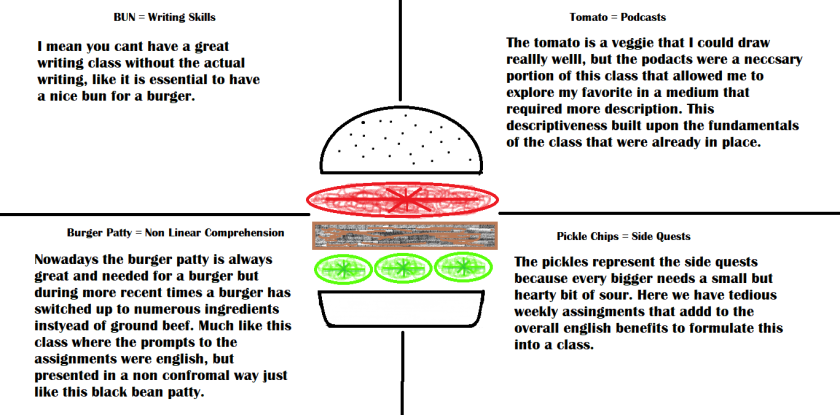
For this assignment, I listed the four main parts of the class work that helped me progress throughout the semester. It can be easily seen through these four sections, which I see as the overall writing skills, the podcasts, non-linear comprehension, and the side quests. Side quest are daily work, they are interesting little activities, but they allow for constant stimulation during down time. Overall writing skills helped me to comprehensively reflect on my poor English skills and hone them. The podcasts helped me, by utilizing teamwork, communication, analysis, and video/audio production. Lastly the non linear comprehension of the assignments benefitted me to think outside of the box and put more effort into my work without the downside of an “impossible” assignment. These portions built the class to a point of stability and likeness to where I got through.

css.php