Play Make Write Think

Assemblies

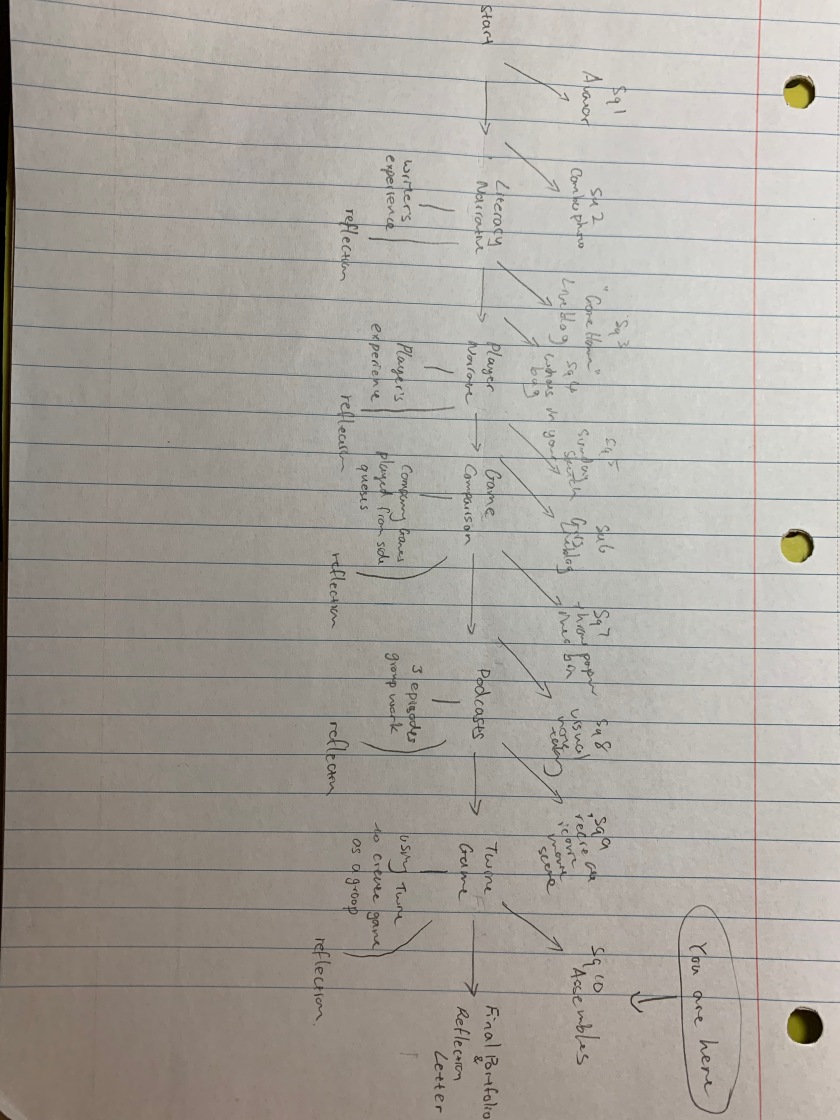
Image drawn and photo taken by Ryan Song

For this side quest, I drew out a game progression diagram like a “select quest” screen in a game that represented all we have done so far. For how this class is organized, what I drew out could also be considered a timeline since our assignments have been organized in a fashion that represents quests from a game.

We have the main quests/assignments in the class shown as the main storyline of the game. Players must complete main stages to progress to the next stage, each with different purposes, playstyle, and lessons.

Following each main quest are the reflections for each, kind of like ending scenes that sums up what went on in the main chapter the players just completed.

 Aside from the main stages, there are also side stories, which are the side quests. Side stories are fun and interesting mini quests that gives players insights into extra information aside from the main story. These might lead to the main stories like how Gone Home Liveblog and Gris Liveblog is necessary before entering the Game Comparison essay stage.

The last main quest in line is the Final Portfolio and Reflection letter, serving as the final ending for the game. It sums up and polishes what has happened in the story line so far, makes sure the players reflect on what they have learned, and leads thinking of possible future fates.

Visual Note Taking

Photo of biology notes taken by myself

The notes posted above are my notes from one of my biology classes. This included a good amount of text since I mostly take notes for the definitions. In term of the relationship between things, I often use drawings to express them.

I’m pretty used to some extent of visual note taking. I would have trouble understanding and remembering detailed facts, which I am not good at, if I were to draw my notes out completely. However, this kind of notes that incorporates images helps me learn about and remember structure of chemical molecules.

Gris Liveblog

Screenshot taken from in game

I’ve played pass the “red stage” of the game so far and have been greatly enjoying it. Gris, while being similar to a 2D side scrolling plat-former, differs in having 3D aspects of games such as needing to turn around to progress or having scenes with staircases on a different z plane than the original pathway.

If I hadn’t been told prior to playing the game that this game was related to the Kübler-Ross model of the five stages of grief, I would not have found the connection through my first run. However, once aware, it’s quite clear with the different stages, mechanics, and background music choice as the game progresses.

I will use the first colored stage as an example of how this is shown. First the whole background changes to red. This color often relates to extreme or strong emotions, such as excitement or anger. Aside from the visual, the gameplay and sound aspects also connect to this more extreme emotion. The level is filled with high winds that prevents the player from moving in places without cover, and the new ability of turning in to a block allows players to go against that wind or destroy obstacles violently.

Sunday Sketch

Swimming in Knowledge

Photo taken by Ryan Song

Sunday Sketch

The Sunday Sketch I made is of a whale (or just a little ball) with the tail of the whale drawn on paper. Where the name came from is pretty clear, it’s swimming on top of words/texts in different languages. The reason I chose to do this had something to do with this little clay ball you see in the photo.

This clay ball was actually something I made back in middle school. It was meant to be a little whale with a tail, but the tail broke off because the connective part was too thin and fractured when the clay was “cooked” to dry in the oven. The body part of the whale is actually hollow inside with small clay balls inside, meaning it can make sounds similar to a bell.

Anyways I’ve always thought it was unfortunate that the tail broke off of such a well-made piece, so I took this chance to give it its tail back drawn on paper. The reason why I used the newspaper/paper with text was just to save paper and make the photo a little less bland.

Game Comparison Essay Reflection

Game Comparison Essay

For this essay, I followed the instructions of the assignment and wrote out a 3-part essay with the addition of an introduction as a hook. Instead of working from a thesis I have already built up, this time I concluded my thesis based on what I have written in the two parts prior to the ending paragraph. Although I have never done this before, I was quite surprised at how easily I came to the conclusion and built my thesis.

While working on the essay, I really got a chance to take a closer look the games I compared/contrasted with a second play through. I was able to find a lot more details in each of them relating to the theme of depression/trauma as I went in with a purpose this time. When I played through “Gris” and “Gone Home” for the first time, was not able to put myself into the situation and feel some of the emotions that I felt while playing through this time.

Twine Game Reflection

Before starting the reflection for creating DMD’s Revenge, I wanted to mention that I feel like our group slacked off when naming this game prototype. We kept the placeholders we used while writing. The only name that appears in the game, DMD, is actually a shorthand for “someone unlucky” as we jokingly decided to call him since he never made an appearance alive.

In the process of creating the game, my main role was to add in detailed descriptions for each of the scenes, making sure the tone of the game is consistent, and putting everything together using Twine.

The story of our game was inspired by an episode from the Japanese TV series, “Unnatural”. Before deciding on the subject of our game, we were stuck when deciding what social issue we should address. One of our members brought this episode and bully up as a theme. After that, while Wendy and Elaine wrote the main storyline, Roy and I worked on adding selection choices and details in scenes to make the story more interactable and game like. While writing out detailed scenes for the game, I tried to shift the perspective of the player onto different characters, hoping to increase their curious about what’s going on.

Looking back at the game, I’m pretty happy with what our group has created. DMD’s Revenge seems more like a visual/interactive novel as it is more plot based with less controllable options and paths to take. If we were to make this game fully, I think we could add in a lot more details into the suicide case itself, making it more of a suspense and even almost a detective game.

We could do this by developing a more complete and complicated case. Then, by adding more in depth interactable characters, a hint collecting system, and making different pathways for players to take based on hints that lead to different endings, give the players more control over their character in the game. Adding on to that, while players shift perspective onto other characters, we could write out parallel ongoing stories with actions that affect other character’s choices. This would improve characters’ development in the game and make the game much more playable repeatedly.

In terms of visual and audio, while it’s good to add them, it’s better to keep them limited to have the players focus on the plot and use their imagination for scenes through descriptions from the text. For example, some background noises of people talking could be added to the classroom scene and some sort of stream notification sound for the stream watching scene. Visuals we could incorporate into the hint system for players to observe and obtain some information.

Aside from the detailed writing, telescoping has been a very important skill as I needed to keep the main plot in mind while managing different options and descriptions for scenes, making sure they make sense and connect to finally make up the whole story.
The Binding of Isaac Podcast Reflection

The Binding of Isaac was our third podcast episode. Having the experiences from the previous Kids and Plague Inc. episode, our group’s planning and discussion became much easier. To be more specific, this time we knew how many meetings we would need, about how much time we need to work on our assigned parts, and the direction of our conversations were clearer and goal oriented when compared to talking about anything that came to mind when creating our first podcast.

Just like our previous episodes, how each group member contributed are not strictly tied into our roles. Each one of us works on all aspects of producing the episode. This time Roy was the producer, he planned out when we were going to meet and decided on the main direction of our discussion. I was the assistant producer, mainly helping Roy guide the direction of our discussion and adding details to what we were going to say in our episode. Wendy was the line editor this time, she made sure everything was put together into the podcast and properly submitted. Like I mentioned earlier, everyone of us contributed equally to coming up with the content of our episode during our discussion we had about the game.

            The goal of this episode was the introduce the game The Binding of Isaac. This game is pretty well known and controversial, so there’s actually quite some topics to talk about, especially about religion and even domestic violence. Other than introducing the game mechanic and some of the key terms, I found it somewhat difficult to decide how much we should discuss about the religion and other sensitive aspects of this game. Therefore, we only stayed on the level on expressing our opinions towards the subject without diving into the should/should nots and right or wrongs.

Looking back at our 3 completed podcast episodes including Kids, Plague Inc., and Binding of Isaac (link to episodes), I would say I’m pretty happy with what we have completed. This was my first time creating a podcast and it was not as hard as I thought it would be. Working in groups have been very helpful as we were able to discuss about our content and have each person work on different aspects of the episodes. The podcast episodes created by the students from the rest of the class in “The Longest Rainy Sunday” series were also very interesting and enjoyable.

Twine Game Reflection

The plot of our Twine game is inspired by a Japanese tv series called Unnatural Death. We adapted from one of the episodes. The main character of our story is a forensic doctor and a bunch of high school students. In the story, the main character DMD undergoes tremendous school violence and begins to seek a solution to change his life. Due to the extreme mental trauma he received, he decides to commit suicide and try to impute his death to the one of the students that has been bullying him. The truth is discovered eventually, which means the main character failed to do so. By the end, we want people to pay attention to school violence, to actually understand what bullying is, which is not a simple physical attack between students. 

The creation process was smooth, four of us decided to split the work. Therefore, we didn’t assign roles. Since I was the only one in our group that had watched the tv series, I wrote the original plot of the game first, and my group mates revised the plot to be more game-like. I think we did a great job choosing the topic, and setting up the framework.

Side Quest 7: Throw a piece of paper into a bin

At first, I really had trouble finding the spectacular way to throw the paper into a bin. When I started to record, I realized those attempts that I failed to throw in made my final throw spectacular. It was actually a hard task to complete, not as easy as I thought. The background music is from the movie La La land, Another Day of Sun.

css.php