Play Make Write Think

The Binding Of Isaac Podcast Reflection

The Binding Of Isaac Podcast Reflection

In the episode of The Binding of Isaac, I took on the role of the main producer. With the past two episodes, our group had always split the role fairly evenly disregarding of our roles, and it was no difference this time. As the main producer, I proposed the idea of the Binding of Isaac, which was a game I have played a lot in my childhood, and again during the pandemic. With the previous experiences, our groupwork has became much more organized and efficient. This only concern was that the game may be a little inappropriate in terms of its mentions and likely negative descriptions of religion.

After meeting with Professor Morgen, we have decided that we will put the concentration on the game’s visual and audio design, its playability, and touch on the social meanings behind it, such as domestic education and abuse. For me, I have always been impressed by this game’s rogue-like design where I can play through it for multiple times without feeling repetitive. The visuals and soundtrack also gave me the creepy, eerie vibe that matches the game aesthetic perfectly. I have always wondered about the backstory behind this game, and due to this project, I had more chance to research and discuss with my groupmates. After some research, we still incorporated the backstory of the Binding of Isaac while relating it to social issues and our lives during the pandemic.

In the three podcast series our group has done, we progressed every time on our collaborative skills and efficiency in fulfilling our individual roles. All of us have became more comfortable working with each other and cooperate better with effective communication.

Assemblies

For this assignment, I mainly listed the four main parts of our class work that help us progress throughout the semester. It can be easily seen that each component contributes differently for our learning and writing. Side quest acts like a daily work, seemingly interesting and relaxing, but also intriguing for us to explore what attitude a gamer should keep; narratives help us to comprehensively reflect on our learning stage in term of game and writing structure. Podcast facilitates us from multiple aspects: teamwork, communication, analysis, and production. It is through these work that we could fully comprehend the concept and knowledge of game.

Side Quest 9: Recreate an Iconic Movie Scene

I absolute hate my own voice like most people, but to try and do a Russian accent is even harder when I cant hear myself. Even though it may not seemed like it this was my tenth take. I have a hard time with “public” speaking and even more so in a foreign accent. This scene is from the TF2 trailer series specifically i chose meet the heavy. It was fun but not enjoyable.

Side Quest 10 Reflection Post

In doing this Side Quest, I actually think I broke the rules in a few ways. Firstly, the image I made doesn’t explicitly reference my own learning. Since the game and the rules of the game are in second person, I didn’t actually show how I individually learned, but instead tried to have the player of the game go through the motions of my learning (the Podcast task explicitly says not to just argue what makes the Game fun, which is one of the traps I fell into in doing the first podcast episode.) The second way I broke the rules was that the writing for the game was not actually a part of the image, rather, it was attached as the rules. I enjoyed making this assignment a game overall.

Side Quest 10

Game made using Gimp-2.10 by Yono Bulis. Inspired by Monopoly.

Rules: Claim one of the three pieces as your own.

Start at Literacy Narrative, move clockwise using dice.

You must master the following at the following tiles to move forward:

Game Comparison: Create inner meaning from two games and then use their similarities and differences to understand an important facet of recovery from trauma.

Depression Quest, Firewatch, Gone Home, Gris: Play the game.

Reflections: Write about what the game meant to you, what you think the developers were trying to say, and how you think they said it.

Movie Scene: Find your favorite movie scene and act in it, making it as real as possible.

Photo-Editing: Practice using Pixlr or Photoshop to make creative edits to photos by combining two photos.

Throw Paper: Throw paper into a wastebasket in the most creative possible way.

Visual Notes: Find the most difficult notes in all of your classes and represent them in a fun, colorful way that is difficult to forget.

Steven Johnson: Understand the key tenets of the first 2 chapters of Everything Bad is Good for Your: How Today’s Popular Culture Is Actuall Making Us Smarter – be able to answer the following questions. What is Johnson’s argument about games? What is Probing and Telescoping? How can games have a medium?

Mary Flanagan: Read through Introduction to Critical Play by Flanagan and denote the main ideas. How are games defined, generally speaking?

SuperBetter: Read the first chapters of Superbetter: The Power of Living Gamefully and write about how games can help us in ways more than just hand-eye coordination.

Ian Bogost: Read 3 of Bogost’s articles: Media Microecology, Empathy, and Don’t Play the Goose Game: Untitled Goose Game is fun. The problem is, all games are also work and free write about the complexity that games instill within us.

Podcast: Create 3 Podcast episodes about games your enjoy playing – collaborate as a group member and make sure your Podcast has a claim – don’t just make it about why games are fun.

End at Player Narrative and Final Portfolio.

Works Cited

Johnson, Steven. Everything Bad Is Good for You: How Today’s Popular Culture Is Actually Making Us Smarter. pp 1-62. New York: Riverhead Books, 2005.

McGonigal, Jane. Superbetter: How a Gameful Life Can Make You Stronger, Happier, Braver and More Resilient. Element Books (UK), 2016.

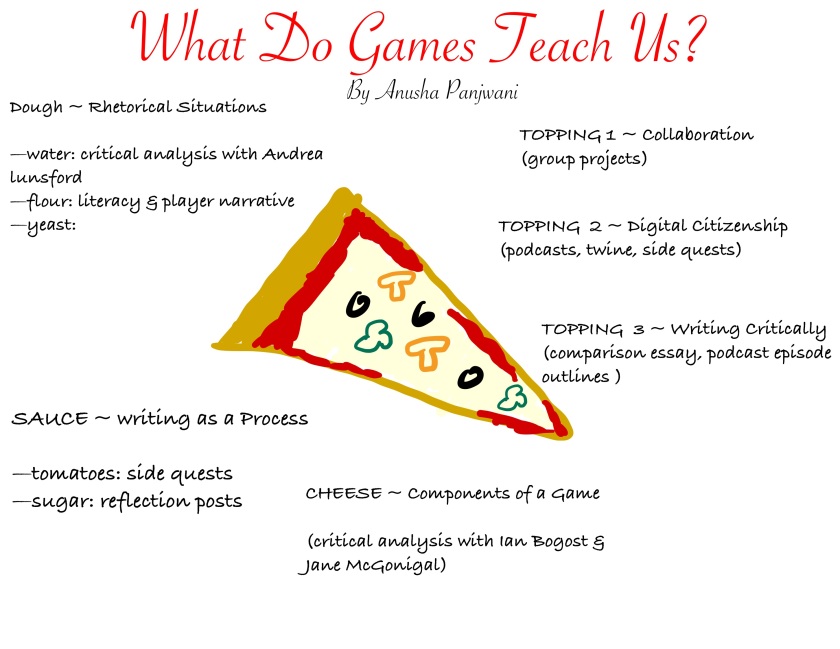
Pizza Assembly

For this side quest, I centered my construction around the question of “what do games teach us?”. I think that in every topic/assignment we explored in this class, we brought it back to what games offer their players. For the components of the pizza slice, I worked around the learning outcomes. Rhetorical situations was the most foundational topic we explored. Writing as a process and components of a game were also very central. For the toppings, I chose facets of this class that came out more naturally as a result of the discussions and assignments we were given.

Assemblies

As suggested by its title, this class has really challenged my abilities on all four aspects – play, make, write, and think. For this assignment, I use each of these aspects as a component for my “Game cocktail” and list all the tasks I have completed this semester that cater to each category.

Reflecting on Groundhog Day

As a member of the production crew for Groundhog Day, I played the main idea person in our twine game. The game generated incorporated a large portion of my ideas and thoughts. To make sense of the twine game assignment, my group used brainstorming to develop ideas that wanted to be heard with no negative feedback, then deciding on the favorite images to be brought into the game. The game was designed to the best of our abilities. I did not have to employ any technology or writing strategy for my role; I mainly just wrote down my ideas on our shared google doc, where we all discussed them. In preparing to present our game to the class, we made a presentation and split it according to our development. I feel like the final product could be a great insight into the high school atmosphere of a senior going through the pandemic. If I could do it repeatedly, I would not do a single thing differently about our twine game.
Working on the twine game, I learned to employ group brainstorming strategies that openly engage in the product. I developed new technological skills on twine because it was a brand new platform for me. Throughout the project, my group used an open environment procedure for game development. The development of Groundhog Day was much like my writing process, blurting out all of my ideas for the assignment, then working at what material works well. I am most proud of about Groundhog Day because it allowed everyone to voice whatever concerns or ideas they wanted for the game without judgment. It was a new process for me, and I hope to bring my development style of videogames to my writing in the future.

The Binding of Isaac

The Longest Rainy Sunday
The Binding of Isaac
Loading
/

Today we will be talking about the Binding of Isaac. The Binding of Isaac is a roguelike game designed by Edmund McMillen Florian Himsl initially released in 2011. Roguelike games are a genre of rpg games that usually have procedurally generated dungeons, to different extents of turn based gameplay, and often pixelated graphics. Dungeons in this case would usually mean randomly generated stages that have different enemies and drops each time players enter them. 

Transcript

Download transcript

Time To Settle This With Catan

The Longest Rainy Sunday
Time To Settle This With Catan
Loading
/

The Settlers of Catan is a game that almost everyone has at least heard of, if not played. Although released in 1995, its popularity is only growing all these years later. There are so many layers and facets to this game, that a single 10-minute podcast episode cannot do justice to it. Still, we try our best to touch upon some of the factors that make this game unique and relevant. ‘Strategy’ is a word that comes up very often while talking about Catan, and we talk about what kinds of strategies we need to use in the game, the way we need to think while playing, and why this is relevant to everyday life. We also talk about why Catan is a more accurate representation of how Capitalism works, as compared to other games, like Monopoly. Lastly, we also mention how the game has an underlying message of Colonialism, and why it is important to recognize that every part of the game has not aged well.

Sources

Transcript

Download transcript

css.php