With my very limited art skills I drew a brachiosaurus (a specie of dinosaurs with the long necks ) using my apply headphone converter as the neck. At first, I wanted to use the converter as the neck of the alien horses in the movie, Avatar, or the neck of a giraffe. Eventually I chose to draw the brachiosaurus because I realized that the thin wire of the converter would more closely depict the ridiculous proportion of this animal. The name, “Lightning Brachiosaurus”, was named after the lightning cable converter designed by Apple. At the same time, the name serves an effect as an oxymoron because brachiosaurus are probably extremely slow, the opposite of lightning.
For me the player narrative was pretty difficult to begin with, since I never have thought or reflected on the ways I play a game ever before. In contrast I was constant taught to do so for movies and books. Through this experience, I learned and realized that games could be as influential and educational as (if not more than) movies and books. As I write more, the easier it had become for me to reflect on myself. I hope that through this narrative I illustrated the message that games do not have to be competitive in order for it to be fun. Writing this piece has brought me back to the memories of putting myself into imaginary worlds of those games I have played, which was beautiful.
I never identified myself as a “gamer”. In my opinion, a gamer would be someone who “feels that their main hobby is gaming, who think about playing their game when they’re not playing it, whose conversation is directed towards video games more so than anything else, who religiously follows game websites to keep up to date with new games…”. In short terms, it means that they would be dedicated into gaming and playing multiple games on the daily. I would define myself gaming habits as a “player”. A casual player of games who gets involved from time to time, finding himself to be fascinated by certain games and only invested in one game at a time.
At a very young age back in elementary school, my grandfather taught me the rules of chess. We used to play at a local park in the morning; slowly, I began to grasp the strategies and gain an intuitive sense of the game. It was the first game that introduced me to all games. I imagined the chessboard to be a real battlefield, where two kingdoms are at war. With 32 pieces on a board, there were unlimited possibilities for me to explore ways to compete against my opponents. I started staying for hours long after the school chess club sessions end in order to learn different tactics from the coach. After a year or so, I could already beat my grandfather and my parents asked the school chess club to move me up an age group because there was no more competition in the age group. Starting from winning against peer members in my chess club, I began to compete among the older members from the local middle school. At the same time, my parents sent me to different local competitions. Soon as I reached this higher level, I began to experience losses. I kept conceding, and there were no peer players whom I could have fun with, making the matter worse. Eventually, I lost interest in playing the game. As I grew up, I shifted towards video and PC gaming just like any teenager in our generation. I started playing competitive and online video games such as NBA 2K and FIFA out of my passion for sports. Even though the gaming platforms had moved from chessboard to X-Boxes and PlayStations, the essence of the game has not changed. I was only involved in games of one on one competitions.
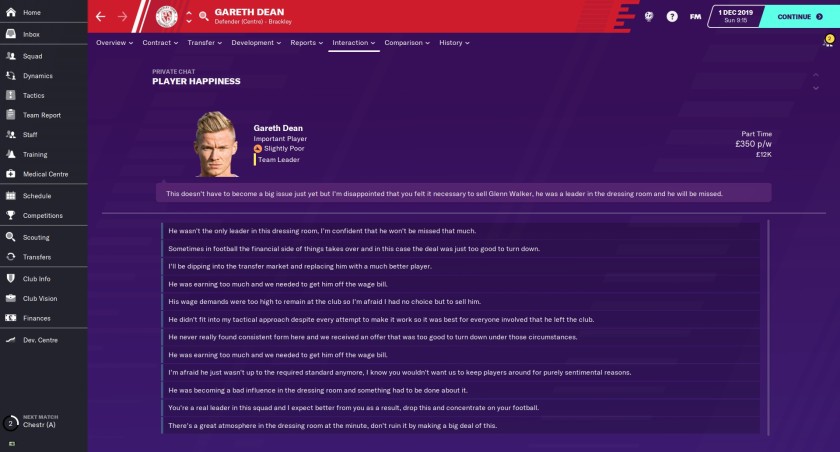
In seventh grade, I discovered FM. FM stands for Football Manager and is developed by the British developer Sports Interactive. I bought the game out of the love for soccer, although immediately discovering its unique qualities compared to traditional soccer video games like FIFA and Pro Evolution Soccer. FM is a sports game, yet the complete opposite of a sports game. In most sports games, the result of the game is the only thing the player gets to decide – through their gaming skills, clicking buttons, and shifting joysticks to score goals. In Football Manager, you get to controlling everything else, except for the outcome of the game. You get to control the transfer and wage budgets, propose different business initiatives for the club, hire and fire all departments of employees, and even attend press conferences before and after matches as well as player signings. Furthermore, FM offers over 500 Gigabytes of player data from all around the world, up to world-renowned teams and down to local clubs’ youth teams that I have even personally played for. The beauty of this game was in its database, its simulations, and its potential for the player to freely explore the world of a sports career while role-playing as a head coach and manager of a soccer club. As a player of this game, I learned that games do not have to be one on one competition that determines a designated winner. In the offline simulation game of FM, even analyzing data could be intriguing. What FM gave me was the ability to sit down for hours to delve into comparing abstract data values.
Gameplay from FM, an important player disappointed regarding the manager’s transfer decisions.
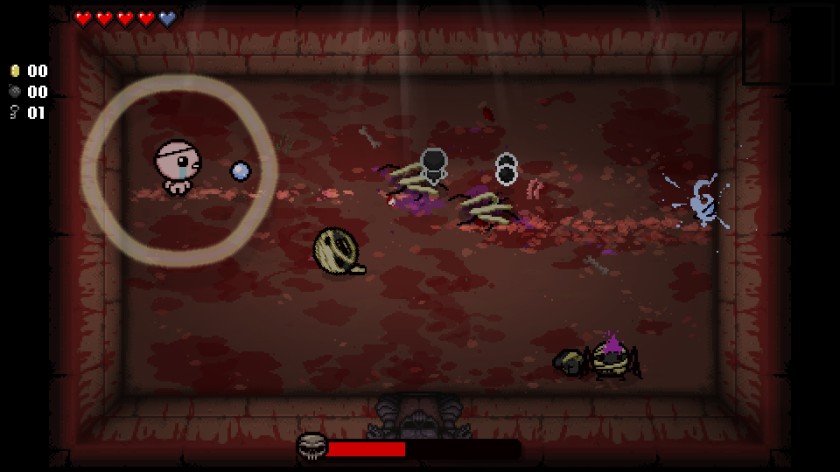
Entering high school, a classmate sent me a copy of The Binding of Isaac, a Biblically inspired indie game. In the game, the main character, Isaac, runs away into a basement filled with monsters in an attempt to run away from his mother’s domestic abuse. I instantly began to play Isaac day and night: for two reasons that intrigued me. The first was its playability. The game was designed in a roguelike manner where players could unlock characters, items, and new levels through auto-generated basement rooms (which look like dungeons rooms modeled after classic 80s games). Due to the vast options for items, new levels, and different monster kinds, the Binding of Isaac could be played through repeatedly and each time with different outcomes and endings. Each ending reveals a little bit more about Isaac’s memories, nightmare, and imagination towards his inner turmoil. This leads to the second way this game has influenced me. The backstory of the game was a conservative and religious family whose father-figure has left the family divorced with a desperate single and conservative mother, who infringes her ideals onto the only child, Isaac. With certain hints, for example, a transitioning of level, players could see that Isaac lost his toys from his mother in exchange for books, was locked inside his room, and forced to study the Bible, etc. Under these circumstances, Isaac began to develop illusions of monsters surrounding him, all inspired by daily items used by his mother to abuse him, as well as names and events that appeared in the Bible. In the game, you get to control Isaac to fight against those monsters, eventually leading to his mother, leading to new levels of heaven, hell, and the womb, where Isaac depicts his hints of depression and suicidal thoughts as a young child. Coming from a family with no specific religious background, I was drawn into the backstories that led to the creation of this game. From there, I began to learn more about religions and spirituality, whereas previously, I did not understand or care about why they were as important as many people consider them to be.
Gameplay from the Binding of Isaac, and its disturbing yet intriguing visual elements within a rogue-like platform.
When our group first came together for the Twine project, we realized that we wanted to show the challenges that one was forced to make early in the pandemic. We had decided on using meters to illustrate the challenging task of limiting COVID risk, keeping money afloat, and maintaining a strong mental capacity without stressors. We eventually realized that in fact, we did not have the capabilities to create meters. Although we were allowed to still incorporate meters into our proposal, this moment was our first reckoning with the immense work that it takes to create a game. As I reflect on this process, I have a great deal of respect for game creators in how they are able to seamlessly incorporate a storyline into the technical mechanics of the game.
Our group soon realized that the best way to develop this game, given our limitations, was through the storyline. Through conversations, we found that our initial game plot was not engaging. Every single person has had to make difficult choices during this pandemic, so why would someone choose to play the exact same scenario? In focusing on different socioeconomic classes, we wanted players to be able to see how the pandemic disproportionally affected people of lower income. In retrospect, we were doing exactly what Ian Bogost explains is part of the micro-ecology of games: creating empathy. In talking about the game Darfur is Dying, Bogost says “those games would do well to invite us to step into the smaller, more uncomfortable shoes of the downtrodden rather than the larger, more well-heeled shoes of the powerful.” In developing the game, we did not care for our players to learn about the frivolous choices that people in the high socioeconomic class, the “well-heeled shoes of the powerful,” face. Rather, by creating low, medium, and high options that a player can choose from, we were hoping to show the contrast in decisions among these different characters and thus have the players really delve into those small, uncomfortable shoes.
An initial challenge we faced when this group came together was finding a time to meet outside of class. Mudita, Pratyush, and Rishika are 10.5 hours ahead of me, so that was a bit of a barrier. I think we found, though, that despite coming from different places we all felt similarly about the struggles that people of low socioeconomic classes faced and were thus able to use all of our experiences to develop the plot. Nevertheless, I am incredibly grateful to the three for inviting me into their already assembled podcast group and working around the time barrier.
In the latest episode of The Longest Rainy Sunday, my group explored the game Democratic Socialism Simulator in which I served as the assistant producer.
In this episode, we focused on how the game poses the argument that the most ideal form of government is a moderate one. The name implies that this is a game that will embrace socialist-like ideals, yet it instead, mocks them. The actual feedback loop and mechanisms of the game shows that when decisions are consistently made under one viewpoint, problems arise. One problem that we focus on specifically, is the bankruptcy of the country when we make decisions that lean left–decisions that in my opinion, are fundamental human rights.
I greatly enjoyed being a part of creating this episode because we were able to incorporate topics from current day life other than the daily despair each one of us faces amidst a raging pandemic. We published this episode only one week after the presidential election, a time when many of us were entrenched in the outcomes because the repercussions for people both domestically and abroad could be severe. We had the liberty to thus reflect on this election and what factors may have contributed to Biden’s win. One point we make during this episode is how this game came out in February, amidst primary season. Many people believed that Biden should be the democratic elect because we needed a moderate president who would appeal to undecided and even republican voters. This viewpoint came at a time when Bernie Sanders and Biden were neck and neck in the race. Coincidently, the description of Democratic Socialism Simulator says that the game is “an attempt to prefigure the opportunities and challenges of a Sanders (or Sanders-like) presidency.” This game may have influenced people to abandon their support for Sanders after playing because it illustrates that a socialist government is unattainable and unrealistic. Other topics that we were able to integrate into our podcast was the role of young voters in this election as well as a reflection on Lincoln and FDR. I think this mechanism of incorporating political issues was very helpful because we were able to share our own opinions on this game and what a moderate presidency really means. In this way, our opinions gave the episode more character and helped it seem more natural.
In respect to the process of producing, I think our group has gotten very comfortable with creating a podcast episode. When we produced our first episode, Temple Run, we were all coming to the task without any experience. Granted, we did choose a game we were somewhat familiar with–yet we were still very new to analyzing a game with a critical analysis lens. Deciding on a game, formulating a thesis, and recording took much more time that first week than it did during this episode. Now, I believe we have the ability to approach any game (including those we have not played) and effectively create an argument. We also very seamlessly have gotten into the flow of creating the other components of this podcast episode like the summary, cover photo, and script. I think that, in the future, if I ever have to create a podcast episode for another class, I would not find it a daunting process.
Given that this was our final episode, I also want to thank Jiachen and Hayden for being really great group members during this process. I think we worked really well and efficiently, and for Jiachen, I have a great deal of respect for coordinating times with us when he was twelve hours ahead of us.
Our group initially was planning on doing Madden as our game, but we found that Fantasy Football is a richer, more analyzable game, even though the game itself is a bit simpler. After deciding that we were doing Fantasy Football, we split up the work. I would say that I wrote a lot for the Google Doc we had for the script, since I have the most experience playing Fantasy, but Ranjan and Andrew filled in the numerous holes in the argument that we had, regarding why Fantasy Football was actually good for you, and not just an unhealthy sports betting/prediction competition. Andrew and Ranjan later did a lot of work actually developing the podcast by editing the podcast and doing the logo. After doing the script and recording, the only thing I did was the Bibliography.
Our episode is different from other episodes mainly in the game itself – Fantasy Football definitely qualifies as a game, but there’s much fewer gamely elements. Although we don’t really discuss this in the episode, Fantasy Football definitely requires less work from the player than the other games we have done before and the games that other groups have done.
Our goals in creating this episode were to demonstrate the value of playing Fantasy Football. Apart from being fun, it also has genuine benefits for its players. It fosters longtime social connections and most of all provides a great introduction to statistics, decision-making, and critical thinking.
This particular podcast felt a bit more similar to essay writing than other podcasts since it felt like the burden of evidence rested a bit heavier on our shoulders this time. I felt a bit like Steven Johnson did in Why Everything Bad is Good for you: How Today’s Popular Culture Is Actually Making Us Smarter, as to me the audience felt initially skeptical of Fantasy Football’s benefit, whereas in games like Minecraft and Super Mario 64, the audience was already to a certain degree on my side.
Based off of this particular podcast episode, a few things I would suggest are extensive research into your topic. In the previous two episodes our group did, most of the evidence we needed was easily available, but for this episode, it was more difficult to find the data we were looking for since it was kind of hidden under a mound of articles disclosing why Fantasy Football was negative for one’s health or articles giving Fantasy advice. Extensive research provided us with a perfect resource; an actual college observational study about Fantasy Football’s relationship to teaching economics.
I would say that my most important contribution was integrating the ‘Groundhog Day’ idea into the project. Prior to this, our group was considering doing a narrative style gameplay, with multiple long storylines. We still maintained elements of this, but by adding an element of daily repetition, a la “Groundhog Day”, it better represented the grueling nature of quarantine, as most people can attest to the fact that for at least a short period during quarantine, life felt like you were doing the same thing every day, over and over again.
One new technical skill I learned in doing this project includes using Twine to storyboard a situation with numerous options. As an aspiring screenwriter, this is a great online tool for planning narratives, as it allows for multiple different storylines based on a character decision. I would say the way me and my group approached this project was very different to the way we approached our podcast episodes, because in our podcast episodes we tried to first develop our argument based on the game’s medium, but in the Twine game, we had to sort of work backwards by creating a medium that fostered an understanding of what Senior quarantine was like. I’m hoping to use these skills as a creator – in writing stories, creating games, or even animating/doing art, I plan to make use of my work in developing a strong medium to express meaning.
Once you’ve completed your game presentation, each student on the team should write a reflection post (around 250 words) that you’ll each publish to your separate sites. Think about and explain in your post how the proposal and presentation help you to fulfill the learning objectives for this course.
Describe the Experience
What were your most important contributions to the group project? What role(s) did you play on the team?
What processes did your team use to make sense of the assignment, brainstorm ideas, and complete the work?
What technologies or writing strategies did you employ to complete your individual work on this project?
How did you prepare to present your game to the class?
How do you feel about the final product that you produced? What would you do differently with the project if you could go back to the start and do it over?
Reflect on Your Learning
What new skills or strategies did you learn while working on this project?
What new technological or design skills did you develop?
Were the strategies, skills and procedures you used effectively during the various stages of the project?
Do you see any patterns in how you approached your role in the writing of this proposal and the other work you’ve done, say on the podcast episodes?
How can you apply the skills you used in crafting this game proposal to future writing projects? Where can you use these skills again?
What are you most proud of about the game that you created?
You don’t need to/won’t be able to answer all the above questions in the space provided, but hopefully they help you to meaningfully engage with the process of reflecting on your work on the assignment.
In the episode of Democratic Socialism Simulator, I became the producer. This time we had an even more clearer focus on the tasks involved. As the producer, I need to lead the discussion on the game, record and edit the audio file, and attend meetings including the meeting with Professor Morgen. Compare to the previous podcast on Temple Run and Oxenfree, I think we are much more organized. We literally had more interactions with each other. Although we had a stricter time due to the oblivion to sign up, we actually find the perfect game within a shortened time frame. For the last episodes, we had to probe on how to record in zoom, who is doing what job, and we had to record several times before the final version. Yet, for this episode, everything is simply going as smoothly as possible
Importantly, the goals and main talking points had shifted significantly compare to the last two episodes. We improved on the “game-finding skills”. For Temple Run, we had barely anything to talk about on its meaning and mechanics; yet for Oxenfree, the mechanics would be a little bit confusing to talk about without having to play the game itself. For Democratic Socialism Simulator, we are intrigued by the complex viewing point it provided towards the ongoing election. Amongst our group we had a heated discussion on the game’s view. Some of us believed that the moderacy element means doing nothing, others believed that moderacy means staying neutral. We even discussed about the historical successful president to prove our point. To be honest, I would not change any part of the content this podcast provided if we had to do it again.
As we have more attempts on the podcasts, the ability to “demonstrate collaborative skills in classroom discussion and while working together on projects and presentations”, as stated in the Learning Objective page, are being tested again. As aforementioned, we had different viewpoints that leads us to different assertions. However, with collaborations skils, we overcome the dividing views and came to a conclusion with everyone being satisfied . With the projects, Anusha, Hayden, and I had definitely became more comfortable working with one another. Although learning how to cooperate is a gradual process, we had made clear progression to mastering this skill.
Being the producer of this episode came with greater responsibility on my end. However, I am happy that everything turned out well and that we were able to have a productive conversation about the game. Oxenfree was certainly a huge jump for us from the first episode due to how polar opposite it was to Temple Run, from the mechanics to graphics to gameplay. It was in a nutshell a much more complex game. When I was writing the script, I made sure we explain the game well before going into critical analysis and exploring different aspects of the game. I think I laid out the arguments in a logical way and everyone had the chance to talk about at least one specific part of the game that they like.

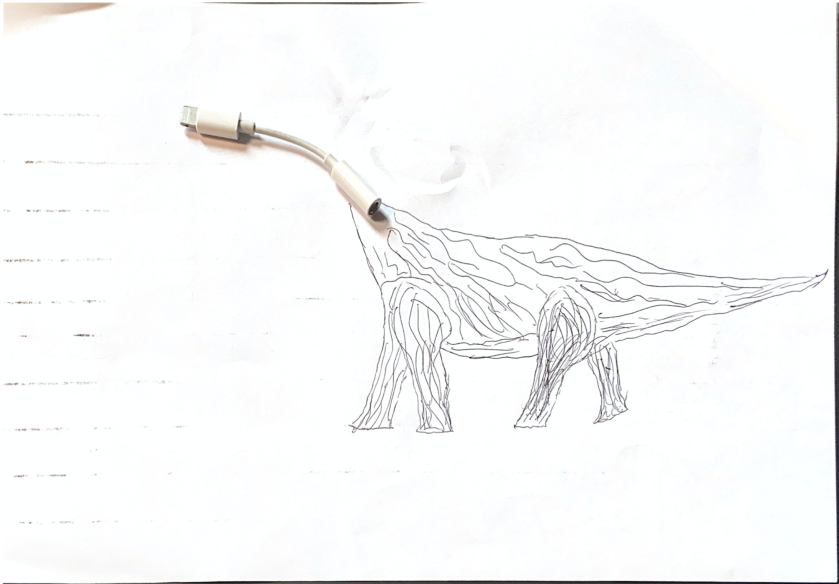
 ) using my apply headphone converter as the neck. At first, I wanted to use the converter as the neck of the alien horses in the movie, Avatar, or the neck of a giraffe. Eventually I chose to draw the brachiosaurus because I realized that the thin wire of the converter would more closely depict the ridiculous proportion of this animal. The name, “Lightning Brachiosaurus”, was named after the lightning cable converter designed by Apple. At the same time, the name serves an effect as an oxymoron because brachiosaurus are probably extremely slow, the opposite of lightning.