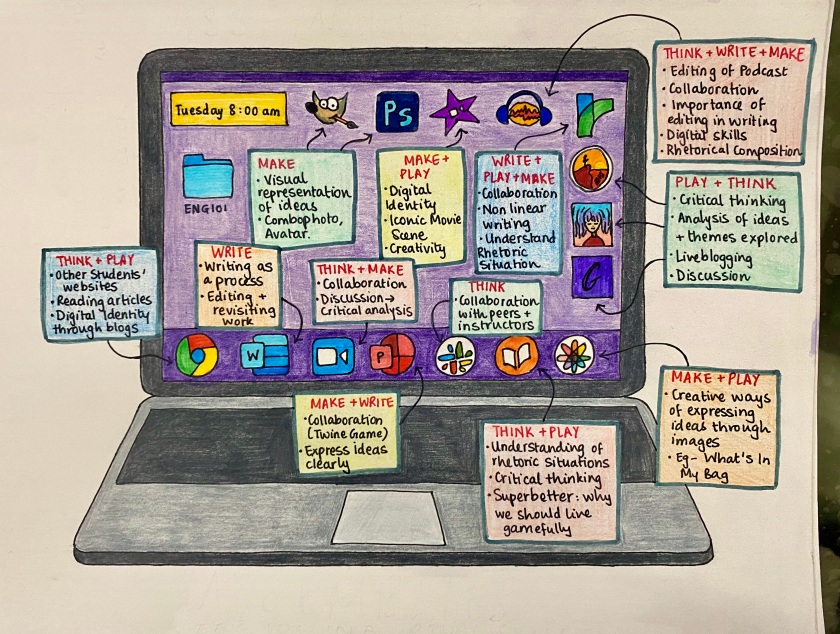
Play Make Write Think

Assemblies

Tea is something that I drink a lot, so this is my take on what makes ENG 101 a good class as ingredients of tea-

  • Tea leaves- the most important component, it’s the major assignments we had like the literacy narrative and the game comparison essay
  • Water- the 2nd most important component, it is the many reflection posts we did for class
  • Milk- the readings we had to do for class which taught us the importance of games and how people try to get over trauma through playing games
  • Cardamom – the side quests that we had to do for each week where we sometimes had to get creative in order to do them
  • “Masala”- this is something that almost all Indian tea lovers put in their tea, it just makes tea even more lovable. This would be the podcasts and twine games we did that made this class even more enjoyable.
  • Cup- the class itself, ENG 101 taught by Professor David E Morgen 

Assemblies

ENG 101 in a Virtual Semester: drawn by me

It has been repeatedly established that 2020 has been an extremely strange year. I was thinking back about how my semester has been, and it’s impossible to do so without visualising my laptop screen. Therefore, for this assignment I chose the represent my learning in the class as a function of my laptop screen. The main takeaway from this drawing, according to me, it just the sheer variety of things I’ve learnt. Each application resembles a different part of the class, and consequently, a different skill I have acquired over the course of the semester. Together, they showcase what the class is all about– “Play Make Write Think”.

Podcast Reflection: Catan

Listen to the episode: Time To Settle This With Catan

Ever since my group began ideating for our first podcast episode, we wanted to do one on Catan. However, we couldn’t do it because not all of us had played it, and we didn’t have enough time to play it. When it was time for the last episode, we blocked 3 hours of our weekend just to play Catan on the online emulator, so that we could base our last episode on this wildly popular game. Our excitement was short-lived because the online emulator we used was a disappointing substitute for the board game. We considered changing the game, but eventually stuck to it because we knew how interesting the board game actually was. I’m glad we made that decision, because after having a couple of discussions, we came up with several unique ways to think about Catan.

A large portion of the episode was dedicated to the game being a model of capitalism. We focused on trying to find out why Catan has been a lot more successful as compared to other games that have a similar premise. We believe that a large reason for this was because Catan is a more realistic depiction of this concept. It accounts for the drawbacks of capitalism too, like its unfairness, and the inherent privilege enjoyed by a certain section of society.

Catan is a game that is really close to me personally, and I had played it many times before recording this podcast episode. Hence, it was difficult to look at the game from a purely objective gaze. This was something that I probably better for Hidden Folks, as I had never even heard of the game before, and thus I had no preconceived notions about it. Working on this particular episode, I think that I was really able to develop my skill of looking at things from a different perspective. It’s very important for me to be able to find new ways to think about things, and thus constantly evolve my thinking capacity. I believe that all of us pushed ourselves to think of such fascinating aspects of the game, and I’m proud of what we achieved through this process. An example of this would be the angle about Catan resembling Colonialism, which is something we came up with only through deep and detailed conversations.

Since this assignment was done in the latter part of the semester, I had a sufficient amount of knowledge about things like rhetorical situations. This allowed me to think of the game as a channel of communication between the creator of the game and the player. It was interesting to think about what the creator was trying to say through his chosen medium (a game), as compared to what we (the consumers) inferred from it, and also how different these two probably were.

I have to say, at this point in the semester, virtual school and 10-hour time differences had finally caught up with my group members and me. It was difficult to find the motivation to work on this podcast, especially so close to finals and several other assignments. Still, I think we did manage to put our best into this work, and eventually created an episode that touched upon several interesting characteristics of this complicated and multi-faceted game.

Twine Game Reflection

The basic premise of our Twine game (Covid Disparity Quest) is to highlight the difference in the way the pandemic has impacted various sections of society. The COVID-19 pandemic took the world by storm this year, and it has disrupted the lives of almost everyone on the planet, especially in populated and containment zones like New York City. However, it is undeniable that it has disproportionately affected marginalized sections of society. This disparity was something Mudita, Pratyush and I noticed in India, and Anusha noticed in the United States. Class disparity transcends borders, and we found this to be very interesting. So, we decided to base our game on this concept.

One of the main objectives of our game was to create a sense of empathy for those who are different, or less privileged than those playing the game. Games are very effective in creating this sense of empathy as compared to things like written texts, as games are interactive, and allow the player to actually ‘live’ the experience in some way. In How To Do Things With Videogames, Ian Bogost says, “If a game […] is meant to foster empathy for terrible real-world situations in which the players fortunate enough to play videogames might intervene, then those games would do well to invite us to step into the smaller, more uncomfortable shoes of the downtrodden rather than the larger, more well-heeled shoes of the powerful.” He talks about how a large number of popular videogames allow players to gain powers, and play characters have more strength that they do in real life. However, there is a certain merit in games that force us to play powerless and oppressed characters. It is only these games that can truly invoke a sense of empathy.

The disparity is highlighted by the choices the player had to make. Rebecca is a college-dropout, an aspiring actress, and a recently-unemployed bartender. She is struggling to makes ends meet, and the pandemic has only worsened her financial situation. As players goes through her story, they are expected to make life-altering decisions for her. She has to choose between risking her health and safety to take a job, and risking exhausting all her savings. There is no winning. This has been the reality for millions of people across the globe in the pandemic. In complete contrast, Crest is an investment banker and a UPenn alumnus. When players choose to play his story, they must make comparatively insignificant choices. For example, Crest must choose between living in his penthouse in NYC, or moving to the Hamptons. His privilege ensures financial stability, and thus he has the freedom to make choices to remain completely safe from contracting the virus. This stark difference in the kinds of options presented in each storyline would drive home the main message of our game.

Creating this kind of game was a great learning experience for me. The writing I had to do for the game was non-linear. There wasn’t just one path the story could take. This was different from anything I had ever done, and it was an interesting experience. This assignment helped me to understand the working of chronology in writing. Each choice the player makes affects the direction the story takes, and so it was essential to recognize how certain actions in a paragraph would affect the actions in future paragraphs. I think this would be a useful skill to have while writing regular essays too, as it would ensure a more coherent and logical sequence and structure of paragraphs. Another important learning point in this experience was the understanding of rhetorical composition. Before writing anything, it was important for us to decide what we’re trying to say through the game (purpose), and who we’re trying to say it to (audience). We also had to take into account our limited knowledge of coding, and thus make the game as technologically simple as possible. Only after considering these factors could we begin creating the game.

I think that this assignment was a good way to put together everything we’ve learnt in the semester so far. After analyzing and discussing several games in class and in our podcast episodes, it was extremely interesting to switch roles and actually be the one creating the game. It was slightly surprising to know how difficult this entire process of making a game is, and by the end of it I definitely had newfound respect for all the game-creators. Lastly, teamwork was an extremely important part of the whole exercise. I think Mudita, Pratyush, Anusha and I worked well together, and complemented each other well. We were able to build on each other’s ideas and produce an adequate end product.

Twine Game Reflection

Right from the beginning of the semester, I was eagerly waiting to do this assignment involving designing a game. While creating a Twine Game with my team, I played the role of a game compiler. My duties involved compiling all the scenes, coding them on Twine Games application, and thus creating the final output. From ideation to the final product, we all had a lot of fun putting it together. 

Our end goal for the assignment was to create something relevant to the current times. Each of us had something to bring to the table. We all had different effects of COVID-19 in mind that we wanted to address. First, we put them down and then tried to combine them together in our storyline. We were a team of four, from India and from the USA. Both the countries faced adverse effects but in their own way. This global perspective helped us add a universal appeal to our game. 

We created a document on Google Docs and noted the points we wanted to touch upon. Then, we started writing the script together on a zoom call. After hours of writing, rewriting and editing, we were ready with a plot which everyone was satisfied with. Then, we divided roles and rehearsed for the class presentation. We divided the content in a way that the person explaining a particular aspect was the one who had done it or suggested it. For example, I gave a demo of the game since I had coded it. This way we could do justice to each part of the game. By the end of it, the distance between us did not seem like a barrier.

I’m very happy with our final product. After the assignment, I sent all my friends the link to the game because I was really proud of our work. Through this assignment, I discovered my inclination towards this mode of communication. If I could go back to the start and do this over, I would have preferred we paid more attention to the character sketch than we did. But overall, it was a fun e=and enlightening experience. Right now, I visualise myself  experimenting with more games in the future.

Recreate an Iconic Movie

from Jimmy Wang’s Youtube Channel

For this side quest, I recreated the famous reflection scene in the movie Shawshank Redemption, when Ellis Boyd speaks to his 40 years in jail. Even though the lines were straightforward and short, the acting was actually much harder than it looked. It took a long time for me to get mentally ready and start recording. But overall, fun quest, and look what I did! I enjoy it.

Side Quest 10: Assemblies

For this side quest, I focused on the materials and assignments that have covered in the course. The side quests, games, narratives, and podcast episodes, all went under the four components, play, make, write, think. Making these four components to correspond with the ingredients of a milk tea, I was trying to make it more understandable and interesting.

Twine Reflection

Throughout this course my way of thinking was challenged. I was engaged by having to often reverse engineer assignments. This would entail me having an end goal and instead working towards it, often I would have the goal and work backwards or have to skip from topic to topic. The best example I could give from the semester was when we were assigned to make a video game on an application called Twine. Most people when they make a game just need a concept with a thought out story, but in my case I had to start further behind. These developers already have people that make their thoughts become reality. I needed to learn how to code the game in Twine before a story could flourish. Then, this concept of Storyboarding was completely foreign to me, but as you can see below I think I did alright. 

“Intro story: Sam is a heart surgeon at the New York Presbyterian Lower Manhattan Hospital. He wakes up at his usual 9 AM time. Today, he will head straight to the hospital where he will perform an open heart operation.  

Story 1) Sam takes the subway to get to work. 

Option 1a: Sam stops by his favorite pizza joint on the way to work.

Option 1b: Sam gets a quick deli sandwich on the way to work..

Option 1c: Sam doesn’t eat anything because he wants to watch those carbs.”

Above, we can see that for a student that has no understanding of this software or even how to make a video game. I was able to produce something that may get enough playtime to put a smile on my face. This ability to not work from point a to point b, has allowed my writing process to become more efficient.  The Twine game enhanced my ability to work in an organized, but more efficient manner. This is truly the skill that I appreciate most from this experience.

css.php