Play Make Write Think

Combophoto

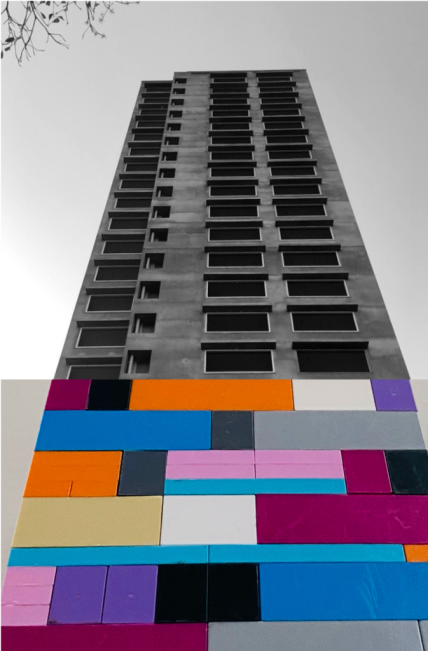
Building Blocks

Thinking of an idea for the combophoto was pretty difficult for me. I wanted to combine two pictures that had some connection, but still were completely different from one another. So, I thought of putting together pictures of things that are opposite in terms of size and colour.

I found a picture of a building I had clicked a few months back– it was black and white. The building represented ‘bigness’. I then found some vibrant Lego blocks, made a tower using them and clicked a picture of them at a similar angle (which was very hard to achieve)– this was the ‘smallness’. The result– this image I call ‘Building Blocks’.

I think that this image, in a sense, symbolises growing up. When we’re young and building our little Lego buildings, our world is small and colourful. We’re oblivious to the hardships, stress and obstacles that life is sure to offer. As we mature, we’re exposed to the big, bad ‘real world’. We have real buildings to build, real problems to solve, and the world just doesn’t seem too colourful anymore.

Combophoto

I combined the pictures of a window with a sunset beach scene. The picture of the window is taken by me several days ago. I found this sunset picture from the app, PicsArt. Using the app, I cropped the picture of the sunset into six pieces, resized them, and fitted into the windows. Living by the sea is always my dream. In the original picture, there was just a tree behind the window. After the combination, the window got a charming scene behind it. At first, I have trouble deciding the pictures to combine, spending time looking for pictures on google and many other places. Then, I found this window picture in my phone, and had the idea to change the scene behind the window.

Week Ahead: 4

4 9/8
9/10* Ian Bogost “Media Microecology” and “Empathy” from How to Do Things with Videogames
9/13

In class on Tuesday, we’ll have two primary tasks:

  • We’ll continue to establish our own working definition for what a game is and to develop the basic theoretical framework we can rely on to analyze games by considering Steven Johnson’s argument in Everything Bad is Good for You and Mary Flanagan’s “Introduction to Critical Play.”
  • We’ll also need to establish the ground rules for the podcast series that this class will be be publishing this semester.

Make sure you have read over the assignment page for the podcast series. You’ll be divided into 6 groups of 3 students for the podcast series, then within each group you’ll take turns rotating through the 3 different roles as you produce episodes. That means by the end of the semester we will have together published 18 episodes of a podcast series exploring how games encourage us to think, feel, and behave.

I am going to encourage you to devote episodes to exploring games that were included in the itch.io Bundle for Racial Justice and Equality this summer. The bundle included more than 1700 independent games and raised $8,149,349.66 for the NAACP Legal Defense and Educational Fund and Community Bail Fund in order to support protestors who continue to march for racial justice throughout the nation. I’ve put together a playlist called Play Make Write Think that highlights almost 50 of those games based on recommendations I’ve seen and based on my own perusal of the list of 1700+ games, just to help make the choice not so overwhelming. I purchased the full bundle and can make games from it available to you for the purposes of critical analysis in your podcast episodes.

In our class discussion on Tuesday, you will all need to be engaged in developing the rules for the series; for example, should each episode be devoted only to a single game or can we be allowed to compare two? and should we make every episode about one or more games from the Bundle, or should we allow the freedom to go outside the bundle for episodes? We will also need to come up with a title, begin drafting the text we’ll record for the introductory bumper, and think about what music we’ll use in the intro to set the tone.

After class, for the rest of the week

After Tuesday, you’ll have two short essays by Ian Bogost that will round out the theoretical foundation texts for the semester. Ian Bogost is a Professor of Media Studies and of Interactive Computing at Georgia Tech, has written or edited ten books on video games, and created the wildly-successful Cow-Clicker, a Facebook game critiquing Facebook games. These two essays are very short but they are fairly dense theoretical writing. Please read them carefully, paying special attention to “Media Microecology.” On September 15, we’ll have a special guest teacher discussing that essay with you so it’s very important that you come to class having read the essay and are prepared to discuss it.

I have also sent you all emails with information about the game we’ll be discussing on 9/15, Gone Home. Your side quest this week is to liveblog your playing of the game.

Wrenchhead Shark

The first thing that came to my mind when I read about this mini-quest was to find an animal that had an object as a part of its name. Like a swordfish, or an angelfish. I decided to choose a hammerhead shark because I thought that it would be the easiest to crop, and I would have the most room for creativity. Now I could obviously just crop a hammer to the shark’s body and call it a day, but I wanted to be a little bit more creative. I wanted to stay in the theme of tools, as a hammer is a tool, so I decided to crop a wrench on the head of the shark. There are a few reasons for my decision. First of all, the head of the wrench looks like a mouth, so my final product could still somewhat look like an animal. Another reason I chose it is because of its symbolism. Wrenches are used to take things apart, but with the ultimate goal of fixing, while a shark’s ultimate goal is to destroy. I thought it would be the perfect tool to put on the head of the shark. In terms of editing, the main problem I had was that in order to fit the wrench head onto the neck of the shark, I needed to significantly enlarge the image, needing to move the picture up multiple times to enlarge the ends. Not only that, but the head ended up being too big. Despite these things, I think my combophoto turned out decently.

The Lost Eiffel

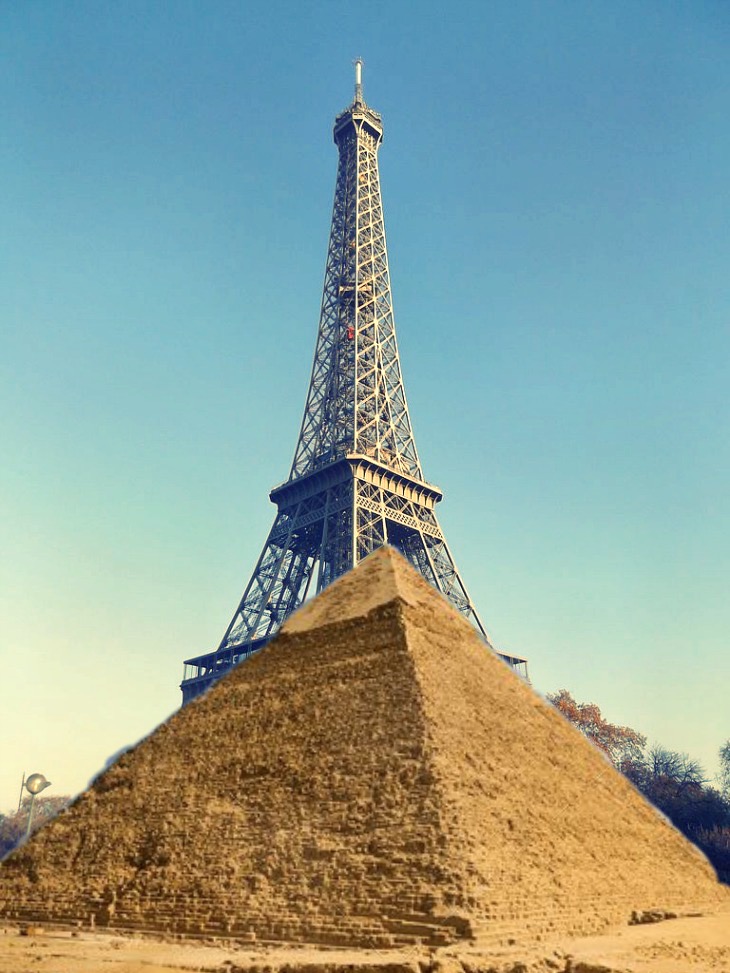
This photo is a combination of Eiffel tower and an Egyptian pyramid. I googled the image of the pyramid and the Eiffel tower.

The moment I started this quest, I thought about putting together something that had the similar shape, or they just simply won’t fit together! Then I thought about the Eiffel tower, the icon and famous tourist attraction in Paris. And I combined it with the pyramid, which could serve as a base to the Eiffel tower. I feel like the Eiffel tower has such a sharp top that made it really hard for me to work from the top. So I chose the bottom. Some of the challenges that I faced was brainstorming and lacking photoshopping skills.

I named my final work The Lost Eiffel because “the lost” symbols everything about the ancient Egyptian culture. It seems mysterious, aged, and in our modern world still no one is able to accurately tell the myths of Egyptian pyramids. The title also captures the contrast of modern and ancient constructions. The Eiffel Tower is a relatively new building compared to the pyramid, as the Eiffel is lost in the grand basis of a pyramid.

Avatar

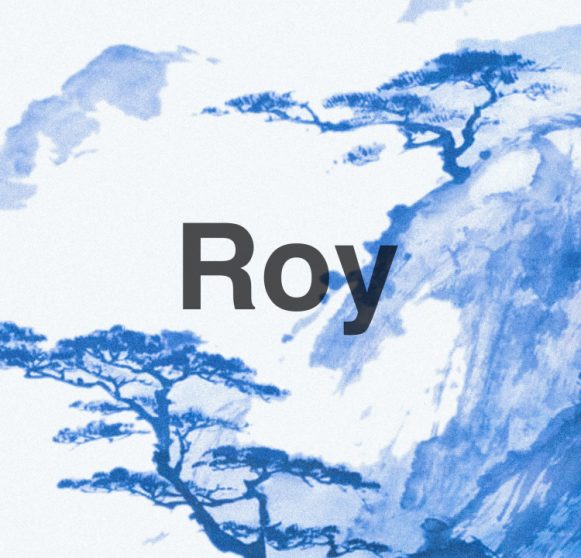
This image is my name on a piece of abstract drawing of trees on a mountain. I modified the original color scheme to shades of blue and white to look like the colors Traditional Chinese Delft pottery. I modified the image this way because I felt that the background represents my culture’s traditional while the gray font represents a modern simplicity.

Literacy Narrative

As a child, I did not learn to read in English like native speakers. In elementary schools in China, the common way to teach English was grammar lessons and vocabulary lists, the same way Spanish classes would be taught in any American high school. Hence, I wasn’t too fond of the English language. The rules to English grammar were never consistent, and I found it to be inefficient in expressing myself. This continued until I became an adolescent. When I entered middle school, I started to listen to a lot of western music. The genres I listened to varied from British rock bands to old school Hip-Hop, and artists like Pink Floyd, Nas, and Michael Jackson were the first writers who inspired me to learn English more thoroughly. I was intrigued in researching the differences between artists of various time periods and hometowns and how their lyrics would vary based on those differences. Songs like “Put It On” by Big L, “Pigs” by Pink Floyd or “Castles Made Of Sand” by Jimi Hendrix. As a result, my first memories with reading English were scrolling through music streaming, reading the lyrics line-by-line alongside their Chinese translations, while searching the words up on an electronic dictionary. Each word had its own melody to it and spoke to my heart. The words became much easier to memorize, and my use of grammar became more intuitive. I learned my first lesson: to treat a language as art, and not skill. I became more accustomed to English grammar rules and verbal conventions. My interaction with English remained this way until my family moved to New York in 2016.

Before my first day in an American high school, I have never been required to write an essay in English over 200 words. My experience with writing before was not the same. I wrote for the grades. I wrote in complex sentence structures to demonstrate that I’ve listened in grammar lessons. I replaced short sentences with long clauses full of never-used adjectives to demonstrate that I did my homework of memorizing 50 vocab words every day. And it was a difficult transition. I received unsatisfactory comments from my teachers, yet they don’t point out what’s wrong with my writing. This continued until junior year, when my English teacher asked me whether if a sixth grader would comprehend my essay. My teacher emphasized on being concise. Avoiding all repetitions and confusions over long sentences. Splitting one sentence into two. Two into four. I reached a realization that throughout all those years my goal of writing was to impress, not express. My teacher gave me my second lesson, which is to write for all people. Be more concise. It was to express my ideas in easier ways so more audience can be reached.

Finally, my third lesson of reading and writing came during the college application process. In those three months, I wrote countless essay drafts for admissions officers to read over. The process was a long struggle of trying to sound intriguing while avoiding clichés; trying to display personal talents while avoiding signs of arrogance. Nevertheless I appreciated this experience. By that last word I typed onto that last essay document, I truly had a better understanding of myself. The collection of my essay drafts becomes a full notion of my identities, my passions and traits. From this experience I learned to write in order to reorganize thoughts. Instead of writing for other people to read, I began to write for myself.
Side Quest 2: Combo Photo

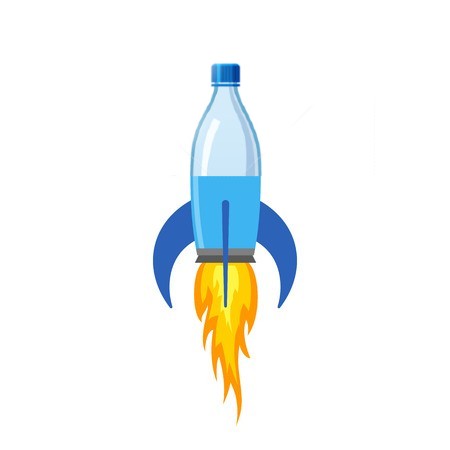
I was looking around my room for inspiration when I noticed my water bottle sitting on my desk. Then I started to think what fun things I could do with a water bottle. Eventually I came up with a play on words of Bottle rocket. As a kid I would make these cute little rocket with an Alka-seltzer tablet and some water. When we got into high school my my friends and I used dried ice and they flew way higher. I wanted to express my love for this weekend activity and fill viewers with that nostalgia from childhood.

The hardest part of making this photo was the formatting the layers. It was my first time using some form of Photoshop that was more than just Snapchat. All my previous experience of photo editing was writing the letter “S” for my streaks. It is quite exciting to learn something new in life on my own. I feel as though the past 18 years have been so guided, so this approach to something new has relaxed me.

A Nostalgic Reflection on My Past

This narrative exercise really made me look back and see just how much the Ranjan of the present was shaped by the reading and freedom of Ranjan as a child. As embarrassing as it is, I truly believe Dav Pilkey’s Captain Underpants series had a profound effect on my writing. Going back and reading some of my earliest writing, I cringe at the jokes I inserted and the characters I made, but I hope one day when I am even more experienced, I can look back on this post and lovingly cringe at my progression. Reminiscing back on my roots really rejuvenated my passion for reading, as well, which waned as technology and quick internet content grew more enticing. It really is fascinating that so much could be based off such little substance, and I hope to base the foundation for having strong academic writing skills off the things I read and do in this class and Emory as a whole!

css.php