Play Make Write Think

Podcast reflection (episode 1)

Overall, I think episode 1 on Temple Run was a success. My main job as an assistant producer was to work on the script and help with generating outline for the episode. Choosing Temple Run was Anusha’s decision and although initially we thought the game was too simple and lacking substance to give us enough talking points, we decided to stick with it anyway. It stems from 2 reasons. First, we wanted to save more complex and mentally challenging game for later episodes. Second, we reckoned that developing a deep analysis for a game as simple as Temple Run would make the podcast much more interesting since we will be talking about ideas most people have not thought of before. And I think we succeeded.

Logistics wise, we started a little late but I am glad things turned out well. In our first meeting, we had a very productive hour bouncing off ideas about how the never-ending, no-winning nature of Temple Run mirrors that of the pandemic situation. Everything just seems static and boring right now. That was the backbone for this episode. We also questioned Temple Run’s popularity given its simplistic nature. It is quite interesting how the most successful game or product on the market isn’t always the most exciting or fancy or complex. This shows a lot about human behaviour and how we perceive things. Sometimes, all we need is a time-passer game, something less “mentally taxing,” something that can entertain us while we are busy thinking about other things. After we gathered all the points, Anusha rearranged them briefly and we started recording on Thursday. Again, we had a really productive hour as we only had to run it 3 times. The result was approximately 10 minutes so we were happy.

I would like to thank Anusha and Bob for making this first episode a success and I look forward to producing future episodes with them.
“Throwing” a piece of paper to a bin

Above is my most spectacular attempt at throwing a piece of paper to a bin. My throw is particularly spectacular because it is not actually a throw. I view my piece of paper as a ball and the bin as a goal in soccer (football for those who are cultured). I incorporated the drawing because I want to give this “throw” a context. I want to convey some meanings with this spectacular throw, hence I marked the successful attempt as a goal.

Throwing a Piece of Paper into a Bin

Video recorded by me

The pieces I used as Dominos for my video are blocks used in one of my favorite games– Quirkle. There was this 4-month-long phase last year where my mom and I would spend 30 minutes every evening playing this game, which is a memory that I truly cherish. But the important part of that story is that every day, after the game got over, I used to make satisfying patterns using the blocks. That is where I got the idea to use the Quirkle (which is a word I love to say, by the way) pieces for my video.

According to me, this amateur video is pretty spectacular. I knew I wanted my ‘throwing of the paper’ to be fun, and also make it seem like a game, and so I think this Quirkle-Domino idea seemed to fit well. Besides, the whole trend of visually ‘satisfying’ things on the internet is something I really (really) got on board with. I’ve watched, re-watched, and re-re-watched tons of Kinetic Sand, slime, hydraulic press, smooth cutting, and cleaning videos on Instagram. So, the coordinated descent of Dominos was right in the ballpark. Still, I won’t lie– the main reason that I think my video is spectacular is because I took 17 tries to get it right! It’s really not as easy as it seems.

Piece of Paper

https://drive.google.com/file/d/1sheVNBAutTV1rVvxm7SunBguFB7ODWtj/view?usp=sharing

I think mine is the best because not all pieces of paper belong to the bin. We should not waste paper and throw it in the bin all the time. We should try to save paper and try to use empty spaces on a piece of paper. This does not mean that you shouldn’t EVER throw a piece of paper in a bin. But, you should try to use pieces of paper that are used only on one side, try to use it as a scratch paper, for math equations or something else. We should try to use as little as paper as possible as it is not ideal for the environment.

Throwing a piece of paper into a bin

Video screen recorded by me while playing “Paper Throw 3D”

These times have implored us to find a virtual substitute for almost everything, from movie nights with friends to attending lectures in person. I thought it was only fair if I threw paper in the bin that way. It was made possible by this game ‘Paper Throw 3D’ on App Store.  

I think my throw is spectacular because it’s taking place virtually in reality. It still took multiple attempts to get the paper in the bin, though, like it would have in actuality. While playing the game, I suggest muting the audio since the music is far from simulating the real-time setting. Leaving that aside, I think we have found a reasonable way around everything. I was amused by the visual effects of the game. In certain rounds, the game literally had a fan to account for the wind. So, I guess the new normal ain’t that bad. No, wait. Nothing can fill the void of attending college freshman year online. 

Throw a piece of paper into a bin

Video edited by Jiachen Zhang

My throws are spectacular because of the number of trials I have done to get the final throw. To me, throwing the ball into the bin isn’t the hard, yet the process of achieving the final goal is more important to me as a player to this “game”. In the video, I displayed several different places of my house, the kitchen, a hallway and the dining room.

Throw a piece of paper into the bin

filmed by Jimmy: Throwing a piece of paper into the bin

This throw is absolutely spectacular because it is an explosive and angry throw. My original plan was to rip the paper slowly and make a throw, however, after failing so many times to actually throw it into the bin, I changed my plan to a powerful. I went with the speedy, here we go!

Hang in there, my guy!

Photo by me.

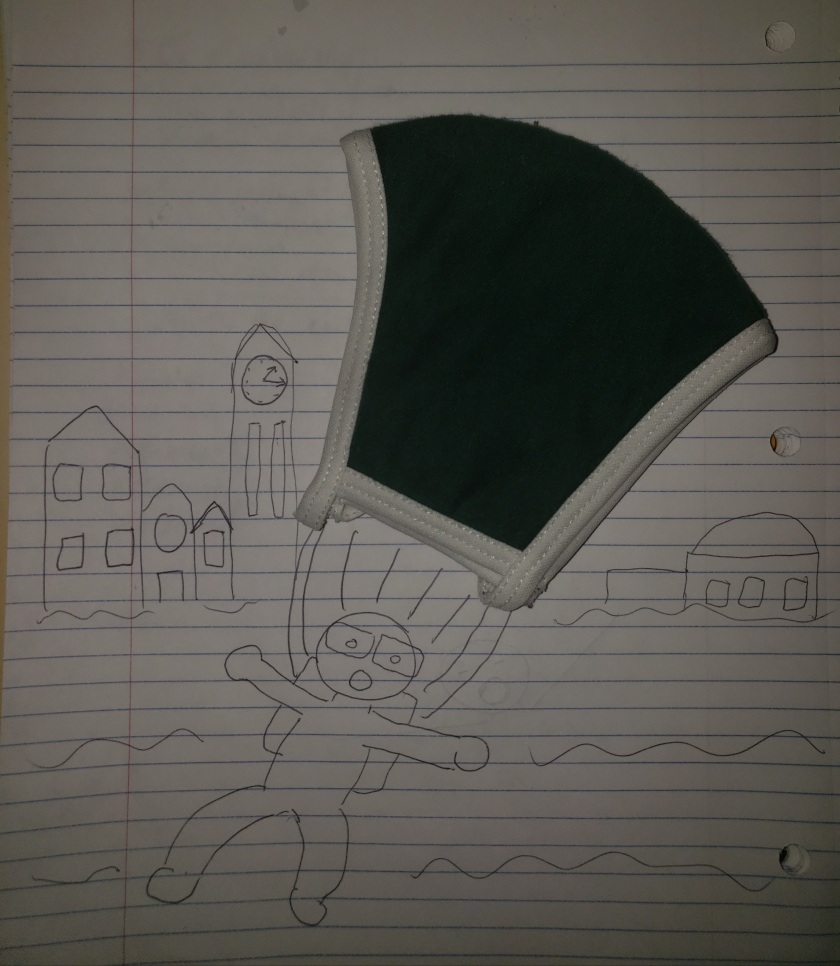
The first object on my desk was this green mask. I wanted to use it for this assignment because it is an interesting necessity in Covid time that I would not have had around me just 7 months ago. I tried thinking of an activity or things that mirror the shape of a mask and realized that the outer curve (when the mask is half folded) looks like it is inflated by air or being flown by strong winds. I then immediately thought of parachuting. The drawing above is only my first try and I am happy with the result. I think my character’s face makes the drawing look more animated.

Gris Liveblog

Screen Shot taken from the game Gris

My first impression of the game was that it had beautiful visual and audio that accompanied the players as they played through the game. I though the game was very successful in expressing ideas with the shifting scenery and style of music as you moved through the different stages.

The game starts off the main character singing, then the world collapsing and her falling down into a colorless world. The girl seems weak in the beginning, but as you progress through the game and collecting little “fragments,” you start learning different abilities and will need to use them to keep progressing and eventually complete the game.

Throughout the game, there are different challenges where you either had to grab “fragments” in a tricky spot or there’s obstacles blocking the way. The player will need to overcome the challenges with simple controls and unlock new stages with the world changing color, representing the different stages of grief. While the game is in the form of a 2D side scrolling plat-former, it does contain elements that are not straight up 2D where players will need to move in both directions to go up or down a path. The side scrolling form of this game represents how people might go through the different stages of grief, but the aspect where players might need to move backwards to progress or collect “secret” fragments shows how the stages are not simply a linear progression, and the girl in this case moves back and forth between them to overcome her challenges.

Gris Liveblog

Beginning: This game got me for a while because there’s no tutorial. I later find that we could either walk to the left or to the right. However, I’m looking for a purpose. What’s the purpose of this game?

“Gris”: Screen shot taken by Jimmy Wang

Color red: So now I figured out that we could actually jump and go to high and low places instead of walking only in horizontal direction. I was quite surprised when the map took me to a really high building through a series of stairs. It’s interesting to expand the playing experiences to a 3D instead of 2D. I love the color red and some of the scenes are very beautiful in this game. However, the music does sound a little melancholy. I’m guessing we should keep looking for colors? And probably Gris’ memories contained many colors and we’re trying to unlock each color by order???

Color green: Very interesting. I get a sense of how to play this game now. Still, three things that stand out for me are a). probing and searching the map b). color and the art design of different scenes c). music. I have to say the playing experience is wonderful. It is quiet and holy. It makes me feel that this game creates a world for me to explore. Then I quit the game and read the Wikipedia about the five stages of grief. Now everything starts to make sense. The colors in this game would match the five stages, which are denial, anger, bargaining, depression, acceptance. So I’m in the stage of bargaining.

Color blue: I observe that some colors are intertwined in each section. For example, when I was in the green stage, there was some red. And now, I see mainly blue but also red and green. I’m guessing these are the details that relate to the tiny psychological changes that take place in the minds of ill people. They’re not simply entering the next stage of grief without carrying any that was left from the previous stage with them. In fact, some parts stay with them and keep having an impact on them. Very careful and detailed design here. By the way, Gris can sing! What a great way this is to remind people that singing can heal the wounds of depressed people.

The end: I’m truly fascinated about this game. I definitely feel empathetic in the end when all the pieces of her body come together. This is truly a journey: a long, spiritual, arduous, but meaningful journey. What strikes me is that this game presents to me that people going through these five stages of grief actually would lose abilities to capture color. They feel vulnerable and they’re locked into their inner world. Their minds are closed to even colors, singing; and it is so hard to heal their wounds and help them gradually open their minds and take in these basic elements of life that we, normal healthy people, take for granted.

Reflection–I’m surprised that Gris is only a 2D side-scrolling platformer because I feel like there are plenty of room and spaces almost like a three-dimensional game. In some sense, they make a 2D game not like 2D. There are so many possibilities, so many places to search and explore. We’re almost taking a journey in Gris’ mind palace, and this gaming experience along with the curation of color and music stretches the maximum of a 2D game. And the game Gris is persuading people to be empathetic and understand the inner world of people who are experiencing grief or depression. Their inner mind palaces are actually full of colors, crys, shouts, and beauty.

css.php