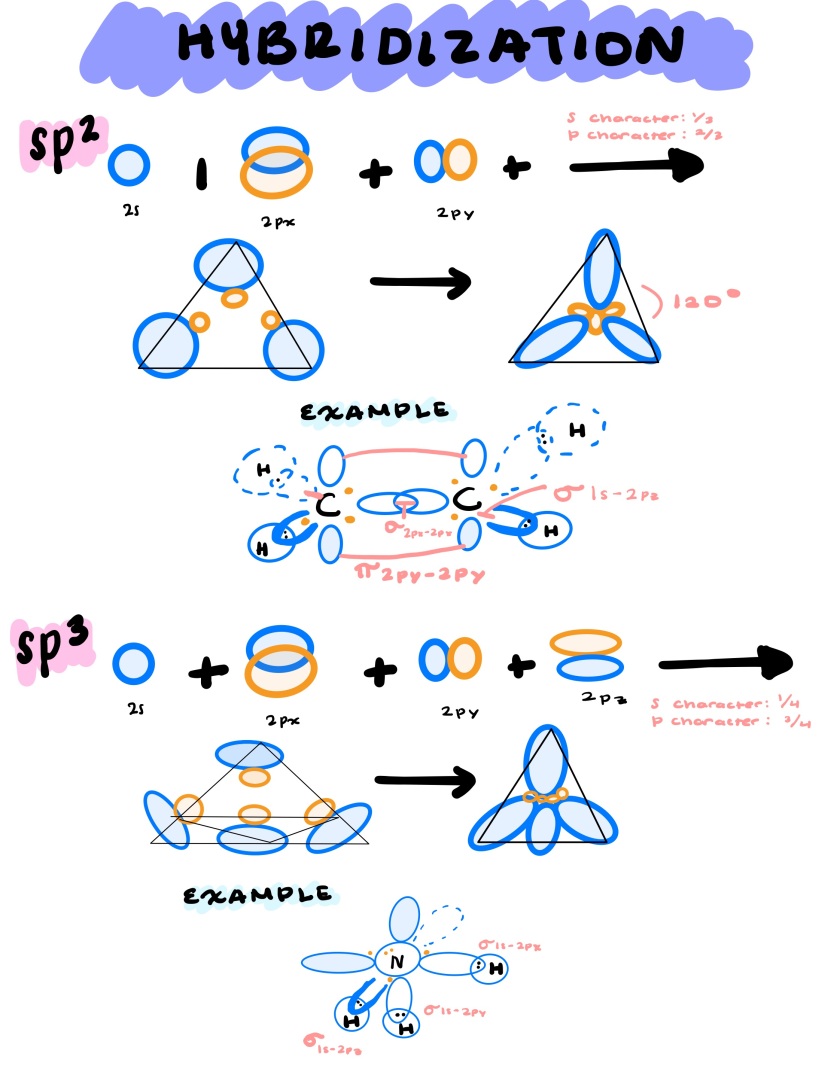
For this side quest, I created visual notes from a day in my chemistry class. We were learning about hybridization and the overlap of orbitals (regions of space where electrons exist) in the formation of bonds within a molecule. My teacher did show images to represent orbitals as it is one of the learning objectives for our class, but I hadn’t drawn and took the time to understand this concept myself. Through these drawings, I was able to solidify the types of bonds created and ask myself how and where I can represent the different lobes of hybridized bonds. I really tried to focus on the drawing of these molecules and limit the number of words on the page.
I switched to virtual note-taking with GoodNotes 5 when this semester started, but I have never used it solely to draw pictures. I find it most helpful when I can write on worksheets and implement images from my textbook interspersed with my notes. I also try not to re-write my notes or create study guides as a studying method because I don’t find it as effective as creating flashcards. I do think my method works well, but this side quest opened my mind up to how to take advantage of my tools and implement drawings as part of my understanding. For example, when I was completing this assignment, I finally understood where the orbitals come from and found gaps in my learning that I don’t think I would have realized previously. In addition, drawing images is certainly more accessible with my tablet given that the app refines shapes and I have a multitude of colors and pen sizes. Previously, though, I would not turn to drawing because I would spend too much time drawing a doodle/diagram out as opposed to actually learning and applying the concept.
For this assignment, I made a visual note page on mathematical induction – a proof method in my Math250 class. The main idea of this concept is that if a statement holds true for some simpler values ( typically 0 and 1), we can assume it holds true for a certain bigger value and then show that it also holds for values above this threshold, hence the statement holds for all values. I enjoy making this visual note because it came to me naturally, probably because Math250 is my favorite class and because I’m an intended math major. One aspect I could improve on, if any, would be coloring. I don’t have color pencils or a device with digital drawing tool with me so my work was rather simple and one dimensional. I am, however, still proud with the result.
Recreate/reenact an iconic movie moment in a short video (no longer than about a minute). You’ll probably need to upload the video to Google Drive or YouTube or even TikTok and then embed the video into a post on your site.
For your sketch assignment this week, I want you to create a set of visual notes for one day in one class (other than this one) that you are currently enrolled in. You do not need to take your visual notes in real time; in fact, I recommend that you don’t. I recommend that you attend classes and take notes in whatever manner you normally do, then after class go through your notes and recreate them as visual notes.
Giulia Forsyth is a visual note-taker and facilitator, which means that she is sometimes employed to go to presentations and meetings and to doodle notes for the meeting. Check out the four minute video below, where Forsyth gives a quick summary of how she began to take her doodling seriously and where it has led her.
Kenneth Robinson
As another example of visual note-taking, you might check out the video below from RSA Animates illustrating a lecture by Kenneth Robinson about educational philosophy. I suspect you’ll find the video much more powerful and engaging because of the illustration that goes along with it than you would if you were simply listening to the audio. What does this mean for your own practice?
Prompt
For your sketch assignment this week, I want you to create a set of visual notes for one day in one class that you are currently enrolled in (probably not this one). You do not need to take your visual notes in real time; in fact, I recommend that you don’t. I recommend that you go to your classes and take notes in whatever manner you normally do, then after class go through your notes and recreate them as visual notes.
You do not need to draw your notes in a digital environment, either, though you are certainly free to do so. If you prefer to doodle with pen, pencil, or marker on paper then do that and once you’re done with your drawing, just take photos of the pages as JPG files so you can upload them to your site. If you have an iPad or other tablet or would like to draw on your laptop or desktop, then you might try apps like GoodNotes, Procreate, Inkflow, or Adobe’s Sketchbook or search for other free/cheap drawing applications. I am completely tool agnostic on this assignment, so make your drawings in whatever manner make sense to you.
Your visual notes do not need to be polished or beautiful or anywhere near as intricate as Forsyth’s. Do try to take this assignment as an opportunity to really engage differently with your material – don’t just make a series of doodles that follow the outline of the lecture or discussion in your notes but try to translate the concepts and information into a new, visual set of notes. You might think about creating flowcharts or diagrams, which are also visual devices.
Once you’ve got your notes, load them onto your course site as a sketch post. Embed the images from your notes into the post and as you do, take a few moments to reflect on the process and then write a paragraph or two about what you learned during the process of creating your visual notes. Did it help you to understand the course content any differently or better to create notes visually rather than just as text? Did you discover anything new about yourself or the way you think in the process? Did you find it enjoyable or find some aspect of it particularly interesting? Someplace in your reflective text, create a link back to this blog post assignment.
When I first read this task I was a little confused as to why this was asked of me but I did it anyway. I got the paper ball into the bin within my first 3 tries and I yelled “Kobe”, then stopped. I still can’t believe that he died and when I first found out I could’ve believe it. I don’t think it has fully settled in regardless. I won’t sit here and say I was the ultimate Kobe fan and I watched all his games because I didn’t. But it still hit a little hard when I yelled “Kobe” and realized that kids in the future won’t get to experience the same warm feeling of throwing something away in class, making the shot and yelling “Kobe”.
So, for the first episode I was the producer for the first episode of the podcast from our team. We met a total of 4 times- decided on a few talking points, a meeting with our executive producer to brainstorm on some interesting point and how to move forward with the podcast, working on our script and decided on some questions for interview’s and the podcast recording day. We thought that instead of dividing up work and working individually we should meet together, which I think is particularly advantageous as I think it was crucial that we met as it was a good way to get to know people and bond in this virtual environment.
Before we even started the podcast, I decided that I would not listen to other podcasts as I felt that, even though it might have its disadvantages, I would have not been able to make points totally different than other groups and analyze the game in a similar way. I did listen to them after them and I really liked them. But one thing we did completely different from what anyone had done was to have 2 guest speakers in our episode, which I really thought was interesting and a fresh perspective as we loved to hear from someone who played the game just for “fun” and not from the point of view of analyzing it.
Initially we did have a bumpy start as we debated what game would we analyze. It had to not only an interesting game, something that would appeal to a larger crowd, but also a game that had more depth to it than just say a game with rolling a die and moving three spaces forward. We ended up choosing Secret Hitler. We discovered that there were variations of the game. But, the reason the game was so successful, was – the underlying message “politics”. Politics is one of the most discussed topics throughout the world, and especially with the events of 2020 I felt that it was something that people particularly related to making the game even more successful in 2020. I think what made this assignment interesting and little restricted at the same time was that the fact we had to make it into a podcast and not just a narration of something we had wrote. All my life I have been used to writing essays so I think it was a challenge as we couldn’t frame it in such a way that it would be an actual discussion, however, when we recorded the podcast the first time, it did not sound good at all. Eventually, we came up with some basic tricks like to emphasize on things we said and talk a little slowly, making us happy with our end result!
As a game player, I’ve been most influenced by the triangle of chess, Minecraft, and fantasy football, whose unique required skill sets morphed me into someone who found new passions and interests.
The first time I played chess, I quickly emerged victorious against my younger sister, who, I should probably add, did not know how to use her knights. After my mom signed me up for an after-school chess program, I played very frequently, taking on a wide variety of elementary school opponents. Being an elementary school chess player, it often came down to creativity to win games: the person who could think outside the box found unique ways to hold onto advantageous positions and capture the ever-so-elusive king. In my most memorable play of chess (from fifth grade!) I mated using a bishop and a rook, as the opposing king, trapped behind his pawn, marked my victory. I’m still proud of it to this day.
Still learning about the game and its infinite niches and possibilities, I try to play often. I’ve learned that chess teaches skills that are in many ways directly applicable to the real world: mistakes can bear heavy consequences, foresight and patience are virtues, and cockiness often leads to failure, just to name a few. But the most important aspects of chess that I learned were analysis and creativity. Not only were they important for winning games, but also for just ‘seeing’ the board, understanding what was going on, and making a decision. Later on in life, I’d find that having the means to look at problems differently contributed to more efficient solutions.
In fifth grade entered Minecraft, a game that’s almost the polar opposite of chess. Minecraft allowed you to simulate the reality you wanted: an underwater house at the bottom of the ocean, a monster-hunting base, and a labyrinth of underground tunnels were all possibilities in Minecraft that real-world architects couldn’t fathom. Exploration and finding your joy is the name of the game. My most fond memory of Minecraft is playing Survival with two of my friends – we built a treehouse base with an attached hut specifically for chicken breeding to have ‘chicken fingers every night.’ Minecraft taught me the value of exploration and visualization, which would come in handy for STEM courses where trying new things leads to more efficient techniques to solve problems. My game-built skill toolbox, now consisting of creativity, analysis, and exploration, greatly changed the way I played both chess and Minecraft, as I found myself employing trial-and-failure tactics in chess games to see what worked, while also analyzing my position in Minecraft to decide what I should do next.
Finally, Fantasy Football entered my life at the start of high school. Fantasy Football, at its core, made me a much better decision-maker. My head throbbing from decisions about who to start and who to sit on any given week, I learned the value of research, fundamental data analysis, and the careful observation of patterns. Being in a particularly competitive league, many of these things came the hard way and had real implications. No one would bail your team out if you made a silly trade, and the inability to make correct decisions on the waiver wire – where you could add and drop players – left you in the dust. Fantasy Football is very different from chess or Minecraft; creativity is swapped with analysis and luck plays a much bigger role, just to name two, but I still found myself using similar skills. My Minecraft exploration sense led me to explore different strategies and employ a trial-and-failure approach to developing my team, while my chess analytical muscle worked overtime, pushing me to give myself every possible advantage through trades and roster changes.
There’s a belief that problems are bad because they provide work and prevent the peaceful utopia society craves, but these games showed me that the idea isn’t for one to rid themselves of problems, it’s to find the right ones, the ones that give meaning and joy. Seeing the way I enjoyed Minecraft, chess, and Fantasy Football, I came to odds with the skills I most enjoyed using: creativity, exploration, and analysis. Using any combination of these skills to tackle a problem – whether in a game or not – instilled a sense of passion within me, and ultimately, it became clear that the problems characterized by these skills are the problems that I should spend my life trying to solve.
A chess game I won – via Chess.com through an iPhone screenshot.
The week our episode was due, I was initially stressed because creating a podcast is not something I had ever done before. Though, I am grateful for Hayden and Bob in how we all came together to produce an interesting and thoughtful episode.
Our first challenge was deciding on a game. While we did start somewhat in advance of the project, we admittedly were constrained by time. When we got together, we all came to consensus that foremost, we had to choose a game that we had all played. Hayden and Bob definitely had played more games than me, so it took a bit of narrowing down, but we did settle on Temple Run. I proposed it mainly because when I was looking for games, I found out that Temple Run is still one of the leading games on the Apple play store. It really does surprise me how games that are no longer in the mainstream view remain popular for quite a few years (in the case of Temple Run it was almost a decade). I wanted to explore this aspect as well as think about the mechanics of Temple Run because I felt that it spurred the era of 3-D simulator games. I was slightly hesitant about pursuing the game because it very much was so casual that it did not necessarily fit into the definition in this class. Though, retrospectively, I think this factor of Temple Run being somewhat of an odd game made it that much more interesting to explore in our episode, especially with the added aspect of the pandemic. We will not be exploring casual games for every episode, though, so for future weeks, we plan to choose games that we are necessarily familiar with.
We settled on roles based on our availability that week, and plan to switch for every episode. The responsibility was split up such that I, the producer, would be in charge of outlining the script of general ideas (including the sources) that we would cover as well as editing the episode. Hayden, the assistant producer, would be in charge of the transcript and Bob, the line producer, would create the cover picture and summary of the episode. We all, of course, contributed to the brainstorming of discussion topics and crafting of a main idea for the episode.
Looking back on my responsibilities, for the outline, I think I should have focused less on creating an actual script because our episode could have seemed more conversational. In terms of editing, I definitely do think I could have smoothed out the background noise or adjusted volumes more efficiently. Overall, however, the activity was more enjoyable than I had anticipated. I think being able to have the creative license to create something (video, podcast) has always been incredibly appealing to me, but I didn’t know how to even begin. After using Audacity and the Free Music Archive, I definitely see that I have areas to improve on, but I feel that operating the tools to create is not as much of a barrier as I thought it would be.
My throw was my corroboration with my baby cousin. The seemingly simple task took several turns for us to complete it. It required to communicate effectively, and I had fun and troubles during the process of working with a young child like my cousin. Thinking outside box to make this task playful also makes it more like a game. Overall, I enjoyed it, and it does not seem as simple as it appear on the first glance.
There was a lot that went into planning our podcast episode, Survival in Minecraft and in Quarantine. Since we were the first group to create a podcast episode, we did not really have much to go off of. We wanted to focus on what made Minecraft such a successful game, and what aspects of it were so endearing to the player. Looking back at it, we could have added more about what one could learn from Minecraft and less on the enjoyability of the game. We may have gotten a little carried away. I don’t think our group really thought of using the roles as a method of dividing the work. We were all pretty excited about recording a podcast about Minecraft, so we all decided to split up the work and make it together. Our first course of action was to write what aspects of games we can analyze and relate it to Minecraft. We chose to look at concepts like probing telescoping in the game, as well as analyzing how the type of game Minecraft is (sandbox) helped enhance its cause. We decided to do a preliminary recording after we put information down, without a script or flow, just to get out some initial points we had, and to test out the feel of the recording. It was successful, and we ended up using some points from that recording in our final one. In terms of organizing the podcast, we decided to focus on the different modes of Minecraft, and our personal experiences with the game. We were flirting with the idea of having a devil’s advocate who never played the game as a character, but we thought that concept was too forced. Focusing on personal experience made our podcast seem more authentic. Then we could add specific terms and concepts to explain our experiences.
In terms of constraints, I do not think our group had many. As the first group to go, we had a little extra time to make our podcast, and we ended up covering all the topics we wanted to. Our podcast ran for 19 minutes, which was a few minutes above the recommended time for the podcast. Ideally, if we were recording in the same room, we would have jumped in on each other’s conversations more, and built of what we were saying. It was hard to signal when we wanted to jump in and out of the conversation, which made it hard to add on.
Our podcast project could be considered the ultimate representation of the class’s learning objectives. We were able to summarize, analyze, synthesize, and evaluate our group members’ ideas during the podcast as well as the works of other writers writing about games. We were also able to undertake writing as a process as described by one of the objectives. We researched different concepts and works that could describe Minecraft and drafted our first podcast run. We revised our information and made a more clear outline in order to make our final podcast episode, and I am now reflecting on that process myself. This project allowed me to go through the writing process, collaborate with others, analyze various works, and use technology to connect to others. Although some aspects of typical essay writing can be found in the learning objectives, such as analyzing works, drafting revising, and reflecting, the podcast project was able to combine all of the aspects into one. I feel like I grew more as a writer and a thinker during my time working on this project. I also grew more open to other mediums of writing and sharing ideas. As an individual, I think I could improve my speaking and social skills when it comes to projects like this, as I feel like I have good ideas, but I find it hard to express them verbally.